Technology Enhanced Learning: Digital Inclusion Forum


Technology Enhanced Learning Logo
Technology Enhanced Learning

Yesterday saw the launch of the newly formed Digital Inclusion Forum set up by the Technology Enhanced Learning Programme, which is funded by the ESRC and EPSRC and directed by Richard Noss here in the UK.

In 2008 BECTA‘s Disadvantaged Learners Report observed that the lack of a single voice in UK policy championing disadvantaged learners has led to unhelpful fragmentation – particularly in addressing digital disadvantage across education.  Hopefully this Forum will help to draw together disparate resources and streams of research and practice to give more cohesion to those seeking to mitigate exclusion within technology enhanced learning.

The Digital Inclusion Forum has two key purposes:

  • To identify key inclusion-related questions and issues for research into digital inclusion issues in education
  • To discuss and evaluate the contribution that the TEL research programme can make to the digital inclusion research agenda.

According to Jane Seale, the group convener, there will be two main phases of activity:

  • The first phase (May-November 2009) will be the development of an online space for sharing digital inclusion related resources, discussing inclusion-related issues and scoping priorities for digital inclusion research. It is hoped the online space will be a platform for the collaborative writing of a web-based document that starts to draw together what the key issues are in relation to digital inclusion research.
  • The second phase (December 2009-September 2010) will involve the setting up of a commentary group who, drawing on the web-based document will co-author a TEL branded publication which offers a commentary on digital inclusion research and highlights the contributions of the TEL projects to the field.

The forum welcomes input, with invitations being issues specifically around contributions to an emergent Digital Inclusion Reference Library and posts to the new discussion forum.

To add any digital inclusion references that you think are relevant and make a significant contribution to the field visit: http://www.tlrp.org/tel/tools/digital_inclusion_references.html

To add to a conversation thread or post a response on the Discussion Forum visit: http://www.tlrp.org/tel/digital_inclusion/forum/digital-inclusion/

The forum also notably draws on blogs and other resources tagged with ‘digitalinclusion’. This marriage of expertise and materials will hopefully accrue into a valuable resource for everyone working to achieve access and equity in technology enhanced learning.

Blogging Against Disablism


This Friday (1st May 2009) will be Blogging Against Disablism Day. This is a day where all around the world, disabled and non-disabled people will blog about their experiences, observations and thoughts about disability discrimination. This is a great event hosted by Diary of A Goldfish. If you’d like to participate, visit the Blogging Against Disablism Day pages at Diary of a Goldfish and register your interest. Everyone is welcome. Then write a post on the subject of disability discrimination, disablism or ableism and and publish it on May 1st – or as close as you are able. In previous years bloggers have posted on all sorts of subjects, Goldfish has more details if you have questions. Multimmedia is also welcome. Be sure to go back to DoaG and tell her the URL of your published post so spectators and participants can share your thoughts.

How People with Disabilities Use the Web


Yesterday the Web Accessibility Initiative (WAI) at the World Wide Web Consortium (W3C) released their draft document “How People with Disabilities Use the Web”.  This document was developed by the WAI’s Education and Outreach Working Group and provides detailed examples of people with different disabilities using Web sites, applications, browsers, and authoring tools. Although a draft, the WAI promise that the document will soon be updated to reflect best practice. Introduction to “How People with Disabilities Use the Web” (2009-04-22) provides a stable reference that will always link to the latest version of the main document.

At first glance this looks like a great introduction to accessible practice for web designers and developers trying to understand the kinds of barriers disabled people can face online. This link also provides a useful way into many of the other materials the WAI have developed to raise awareness and access.

Internet Tools for PhD


This week I belatedly took at look at the Guardian Top 100 Website listings for the year ahead (2009). This is always an interesting read. New Entries vie against previous success stories, and the chart’s Non-Movers are frequently a good indication of developer’s hard graft and continuing innovation.

The list covers several areas. For fellow (PhD) researchers and those interested in potential educational tools, I’ve shortlisted and annotated the topics I found most relevant:

Visualisation

Visualisation is the final category on the Guardian list, but I begin with it as it is the most relevant to those seeking new tools for data manipulation.  Three sites are listed, foremost amongst them being Google Visualisation tools,  featuring dozens of tools for making data more comprehensible. Of these tools I noticed Motion Chart, a temporal-visualisation of data that appear to be surfacing from Google’s acquisition of Hans Rosling’s GapMinder project. Notably there also appear to be tools for creating Sparklines, an efficient visualisation originally pioneered by the ‘Da Vinci of Data’ himself, Edward Tufte. Other sites recognised by the Guardian are Many Eyes, IBM’s visualisation tools, similar to Google’s and DabbleDB which allows you to create online databases and analyse them.

Create/Collaborate

As someone desperate to avail themselves of Apple’s Keynote for presentations, I was interested to check out 280slides cited as ‘A presentation create presentations online. Very slick.’ Alternatives to PowerPoint always bear investigation – although this appears to be a fairly PPT dependent app so far.  Dipity is also listed and offers the opportunity to build multimedia timelines. If you’re plotting the course of your studies, or want a reflexive tool for realtime use, this could reward experimentation for those using varied sources. My addition to this category might break the no-download rules, but I’d also recommend the Open University’s Compendium for wicked problems and solo or communal mind mapping.

Blogging

Research diaries and journals are vital to those developing reflexive practice, blogs also offer the opportunity for PhD students to share research and develop an academic presence online.  An increasingly streamlined category, this year the Guardian cite only WordPress for content creation and Bloglines for managing your feeds.  The management of social information is a strong theme in this year’s list.

Physical from virtual

I’ve previously blogged on available small scale printing from Blurb and others. The Guardian also raise London based Moo for business cards and Lulu another stop for book, photobook, calendars and other sorts of publishing. I’m still dreaming of a 4-colour thesis.

Twitter, and associated

For those trying to surveille the social web, Monitter offers a useful service for watching keywords on Twitter. Importantly, no log-in is required (as of April 20th).  Again, this is the second highlighted service that deals specifically with filtering mass generated social information.

Video

If you’re looking to share video consider Vimeo for better rights control than YouTube and a cleaner interface.  My addition here is Easy YouTube a more accessible interface built over YouTube that removes a lot of the complications and distractions users have to wade through. This was developed in response to the AbilityNet Web 2.0 conference, which highlighted (amongst other things) the inaccessibility of Web2.0 tools for people with learning disabilities.  There are also rumours of developments for captioning (subtitles) on YouTube circulating at Accessify. Exciting times!

Virtual worlds/MMORPGs

Second Life is notably absent from this year’s list. Moshi Monsters crops up as an “educational” virtual world for kids.

And finally, The Guardian lists Cartoons, as ‘eveyone needs some relaxation’. Absent, but nontheless essential viewing for postgraduates everywhere is Piled Higher and Deeper, the only PhD based comic strip you’re ever likely to need.

Games and Virtual Worlds for Serious Applications


VS-Games 2009
VS-Games 2009

Today is day 2 of the ‘VS Games ’09 Games and Virtual Worlds for Serious Applications Conference hosted by the Serious Games institute. The event is available online in two places.  If you have a SL avatar and the inclination, you can attend via the Serious Games Institute’s Virtual Auditorium in Second Life at:

http://slurl.com/secondlife/SGI%20Nexus/96/107/27

If you prefer a more low-key, incognito approach there’s a live stream available on the Serious Games Institute website at:

http://www.seriousgamesinstitute.co.uk

Due to some technical glitches I missed Nottingham’s Prof. Steve Benford this morning, however, I’m hoping to catch two presentations from the Health and Cultural Heritage strand this afternoon:

13:50 – 14:15 GMT (06:50 – 07:15 SLT) ‘Serious Games for Upper Limb Rehabilitation Following Stroke’ by Burke, McNeill, Charles, Morrow, Crosbie, McDonough.

14:15 – 14:40 GMT (07:15 – 07:40 SLT) ‘A Sensory Gate-Ball Game for the Aged People and its User Interface Design’ by J. Kim, Kang, Yang, D. Kim.

The event is sponsored by BECTA and the Association for Learning Technology amongst others. For those who are interested in finding out more, or adopting a more lo-fi approach, please note that the proceedings will be published by IEEE*.  Select papers will also be published in one of two international Journals: Visual Computer and the British Journal of Educational Technology.  More details are available via the Serious Games Institute.

*The I.E. Who? In their own words, the IEEE name was originally an acronym for the Institute of Electrical and Electronics Engineers, Inc. Today, the organization’s scope of interest has expanded into so many related fields, that it is simply referred to by the letters I-E-E-E (pronounced Eye-triple-E).

On the Move


image of article
U21 Newsletter

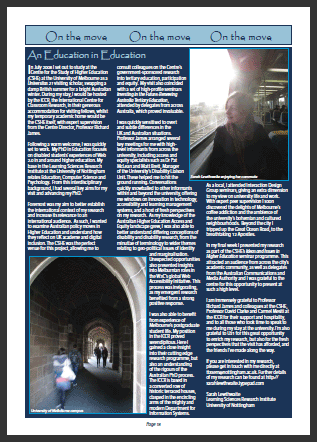
The March edition of Universitas 21 newsletter (Issue 14) is now online. Look out for ‘On The Move’ on page 18, for an article on my trip last year to the Center for the Study of Higher Education and International Centre for Classroom Research at the University of Melbourne. To view, click on the link below.

Universitas 21 Newsletter (PDF)

Social Networks and Passion


Tomorrow (Friday 20th March 2009) Bernd Ploderer will be presenting his research at the University of Nottingham’s Mixed Reality Lab.  Bernd is a visting PhD student from the Interaction Design Group and Department of Information Systems at the University of Melbourne, where I met him last August.  His research focuses on computer supported cooperative work (CSCW)  especially in the appropriation of social network sites to pursue extreme passions such as bodybuilding.

The seminar runs from 12 noon at the MRL and will be of interest to anyone researching social networks, risk, ties, ethnography and obsession.

32 Days Migrates!


Today 32 Days Remaining found a new home at WordPress.  This is the first of what I hope will be many happy posts here.  Returning readers will note that there are a few differences, mostly for the best – however I ask that you excuse any glitches, broken links or missing content that you find in the archives in the short term. I’ll be ironing these out behind the scenes over the next few days and weeks.  Feeds and Podcasts will be back in place soon.  Any comments or advice on your response to the changes are very welcome.  See the current ‘About’ page for more details.

Nottingham Research Network (SEN) Conference


Last week saw the 3rd annual Nottingham Research Network conference focusing on SEN, Social and Educational Inclusion, Health and Disabilities. I was only able to attend the latter part of the day, but as ever, this proved an interesting and useful event, focused on the practicalities of teaching and learning in the City of Nottingham. As ever, the strength of the conference came in its collaborative nature, with valuable contributions from teachers, parents, Children's Services, and academics from both Nottingham and Nottingham Trent Universities.

If you'd like to join the Nottingham Research Network – or view any other information on the network please go to http://www.nottinghamcity.gov.uk/sitemap/services/education_and_learning/nttm-research-network.htm

BETT 2009


January 14th-17th sees the behemothic BETT show roll into the Olympia in London. This is the world's largest Educational Technology event, and I'm looking forward to glimpsing the future of assistive technologies and technology enhanced learning environments, particularly for Higher Education. I'll be attending on the Friday. See you there?