Accessibility and Hierarchies of Impairment


Following on from yesterday’s MRL lecture, I was fortunate to talk with Prof. Dame Wendy Hall about my research and a short paper I’ve written on ‘Aversive Disablism and the Internet’, borne out of Blogging Against Disablism Day. This paper has been accepted for the 1st Symposium for Humanities and Technology Interface 2009, at the University of Southampton in July. The Symposium looks to explore many of the themes of Web Science advocated by Dame Wendy and other Soton and MIT colleagues, alongside more diverse interdisciplinary projects.

Interface requires that all delegates present either a Lightning Talk of 2 minutes, or a poster presentation.  I’ve pulled on my size 6.5 Lightning Boots, and opted for the former presentation style – and in conversation with Dame Wendy had a chance to rehearse my pitch on aversive disablism and it’s relevance for advancing debate and action on digital inclusion. Professor Hall immediately related this notion back to W3C web standards and asked my view on this – was I stating that (dis)ablism occurred at this level?  This turned the conversation to hierarchies of impairment.

Within accessibility practice (as in many other spheres) research and resources frequently prioritise certain communities and their requirements above others for a nexus of reasons.  In brief terms, hierarchical views of disability and impairment have been researched since the 1970s, but in 2003, Deal published Disabled people’s attitudes toward other impairment groups: a hierarchy of impairments (Disability & Society,18:7,897-910) to explore potential inter-group discrimination amongst disabled people.  Deal’s thorough review of the literature relating hierarchic understandings of impairment by both disabled and non-disabled people is essential reading.  Deal concludes with a call for research in this area, and notes that:

…it is important that, whilst disabled people fight a common cause in seeking equality within society and the removal of discriminatory practices, strategies for attitude change are targeted in a manner that makes them most effective. This may include focusing attention on impairment groups that face the most discrimination in society (i.e. those ranked lowest in the hierarchy of impairments), rather than viewing disabled people as a homogenous group.

Deal’s later PhD research explores the nuances of this hierarchy. His thesis Attitudes of Disabled People Toward Other Disabled People and Impairment Groups from 2006 can be found hosted at the Enham Research pages.

When relating these sociological frameworks to the internet, there is no doubt that, in pro-disabled accessibility discourse, certain groups are privileged above others. Whilst there is increasing sensitivity to this in Computer Science, with developers and researchers working to close the distance, this reasons for this divide are under-theorised within ICT discourse.

Much accessibility research focuses strongly on achieving accessibility for people with mobility, sensory and some text impairments – this is clearly important work, however, it does not represent the totality of necessary accessible practice.  For example, when Brian Kelly and others cited limits to the W3Cs Web Accessibility Initiative in their paper 2007 Accessibility 2.0: People, policies and processes they upheld Joe Clarke’s observation that the WACG development process lacked adequate provision for users with cognitive disabilities and learning difficulties.  Kelly et al also cited Lisa Seeman’s formal objection to WCAG 2.0, requesting that implicit claims that the guidelines did cover cognitive disabilities be omitted from the guidelines’ abstract altogether.  I would argue that this is one example of an occassion where cognitive and learning disablities have been afforded lower status in development discourse history and suffered aversive disablist outcomes as a result.

Clearly, accessible practise contends with the grey areas of potentially conflicting subjectivities. But viewed in light of Deal’s call to arms; adopting theory and strategies emergent from disability studies in the heart of mainstream internet practice would, I feel, create stronger debate pushing foward positive outcomes for all disabled people.  Is this a matter for a ‘Disability Web Science’?
Hyperland


Earlier today, Professor Dame Wendy Hall gave a presentation at the Mixed Reality Lab here at Nottingham as part of the MRL’s distinguished lecture series.  Her lecture ‘What is Web Science and why is it important?’ scoped the Web Science Research Initiative as an emergent discipline, discussed the semantic web, and, by way of introduction, described her own route into Multimedia.  If you want to hear more on this from Wendy herself, Nodalities are hosting a podcast interview with Professor Hall covering just these topics.

Amongst other sources of inspiration, Prof. Hall cited Hyperland (1990) a BBC2 ‘fantasy documentary’ by Douglas Adams. This 50 minute film examines (then) contemporary cutting edge research through dream encounters with a software agent (played by Tom Baker) and hypermedia visionaries such as Vannevar Bush and Ted Nelson, to propose how interactive multi-media might constitute the future of TV.

As Douglas Adams’ website notes, whilst Adams was creating Hyperland – a student at CERN in Switzerland was working on a little hypertext project he called the World Wide Web…  To discover this vision of futures past, watch Hyperland below.

[googlevideo=http://video.google.com/videoplay?docid=7190175107515525470]

UK Digital Economy Research Hubs


April 29th saw the launch of three ‘digital economy hubs’.  Three new centres based in Nottingham, Newcastle and Aberdeen will ‘develop digital technology to transform the lives of older people, people with disabilities, and people in rural communities’. This is inclusion ‘through the digital economy’. The Nottingham hub will focus on ‘always on, always with you’ technology. Aberbeen will focus on how technologies can benefit rural communities.  Newcastle’s remit covers ‘new technology for social inclusion’. According to the blurb this concerns:

Making sure everyone – young, older and disabled – is included in our digital future. By 2050 more people will be over 65 years of age than under 16 in the UK. Newcastle will work with older people to design simple, intuitive interfaces tailored to their needs.

The Newcastle Hub is the first to launch a website and can be found at: http://research.ncl.ac.uk/side/.

BSL Video Resources Online 2


Last week I blogged about Art Signs – an excellent video resource produced by Wolverhampton University, specialising in BSL vocabulary relevant to those in the arts, (higher) education or (in my case) digital media.  Yesterday I spoke to some colleagues looking for wider vocabulary, so here are some links to other extensive glossary sites developed by Wolverhampton for those building skills in BSL in Further and Higher Education…

  • Science Signs
    Including glossaries for anatomy, biology, chemistry, genetics, physics, environmental science, geography and geology.  If you want to know what the sign for deoxyribonucleic acid is, you’ve come to the right place.
  • Engineering Signs
    Including glossaries for architecture, construction, housing, surveying, computer aided design, civil engineering, electronic and electrical engineering and mechanical engineering.
  • Secondary Curriculum Signs
    If the above university websites are over whelming, a reduced dictionary is available via the Scottish Sensory Centre. They also deliver the ‘crowded cottage‘ which features some household and day-to-day signs alongside some fun colloquialisms.

Interactive Technologies and Games Conference: Education, Health and Disability


Last year I was part of the organisational committee for the first Interactive Technologies: Education, Rehabilitation and Disability conference at Nottingham Trent University. The conference now enters its second year, with strengthening ties to the Game City festival and a view to a special edition of Computers and Education in 2010.

The conference aims to bring together academics and practitioners to showcase practice and to show how research ideas and outcomes can be mainstreamed. It will introduce a wider audience to key findings and products from research and will illustrate how practice feeds back into and informs research. Joint academic-practitioner papers are welcomed; the conference will create a forum for two-way communication between the academic and practitioner communities.

This years’ conference, titled ‘Interactive Technologies and Games: Education, Health and Disability’ will be held at NTU in Nottingham on 27th October 2009.  If you’re interested in attending, exhibiting or presenting at the conference, the important dates have been released with the call for papers. This is a Word Document and opens in a new window.

The deadline for submissions is Friday 26th June 2009.  There is a conference fee of £60 (concessions £30). I’ll add details of the Conference website as these are confirmed. For those specifically interested in the Disability Strand, topics to be covered (but not limited to) include:

  • Approaches to making Virtual Environments (VE), computer and video games accessible by all
  • Assistive technologies for people with disabilities and elderly people
  • Practical applications of VE and serious games for the education of people with disabilities and elderly people (in e.g. work preparation, travel training)
  • Location based services for navigation and reconnection of people with disabilities
  • Art and music rehabilitation in 3D multisensory environments
  • The engagement potential of serious games for young people at risk of social exclusion (e.g., offenders, those with learning disabilities)
  • Design for All
  • Including people with disabilities in the design of serious games, assistive technologies and VE.

Net Generation: Critical and International Perspectives


On Monday 11th of May 2009, the Open University will broadcast their ‘Net Generation: A critical and international perspective’ mini conference online. This event is part of the OU’s Net Generation Encountering eLearning at University project, and has particular relevance for those researching the use of new technologies in higher education.

Registration for the event is now closed, so this web cast represents a welcome entry to the day’s proceedings. If you are interested in ‘attending’ any sessions or finding out more, you can view the web cast and related information via: http://stadium.open.ac.uk/webcast-ou/

The web cast will go live between 10.00 am – 4.30 pm in the UK (9.00am – 3.30pm GMT).

BSL Video Resources Online


I’ve been taking a CACDP British Sign Language (BSL) Level 1 course this year to develop my communication skills. My final exam is in a few weeks, with a topic focused specifically on work.  Early in the course our course tutor John Smith, put the group in the way of newly developed BSL Online Learning Support resources for students studying our CACDP Level 1 course and as our vocabulary has developed, the value of such online video resources have become more and more appreciated.

The CACDP site is great for very basic vocabulary, but due to my academic background I’ve been searching for other online resources to use in tandem with the course to help revise specific vocabulary around higher education and learning sciences.  During this search I’ve discovered the excellent Art Signs.

Art Signs is a glossary site from the University of Wolverhampton featuring  hundreds of signs for the Arts categorised by discipline, alongside those relating to research, learning and teaching.  Signs are listed alphabetically and thematically. Clips are short and speedy – but this is a comprehensive database.  Everything from file types and internet terms, through methodology, to teaching and learning vocabulary is on there. Art Signs rewards careful searching and will be of great benefit to those working in Education, Research, Media, Technology and the Arts.

Web Development and Aversive Disablism


Blogging Against Disablism Day, May 1st 2009

At A Pretty Simple Blog, James Coltham writes a great article as part of Blogging Against Disablism Day considering the origins of ‘disablism’ and reflecting on the ways disablism plays out through web developers’ actions when creating inaccessible content. I recommend reading his post in full, but to crudely paraphrase, he observes that ignorance is no excuse:

Many will argue that if they do not know about the issues, they can’t be guilty of being ‘disablist’.

Further more, when considering accessibility on the web:

I struggle to think of a valid reason why a web professional should not know about, and practise, web accessibility. Of course, accessibility isn’t binary, and there are many grey areas. But the fact that we still see many of the “school-boy” errors (missing descriptions for images, text that won’t resize, etc) means that there is a long way still to go to get anywhere near an acceptable global standard.
And like it or not, every single person who makes the choice not to spend the 20 seconds giving that image a suitable description, or thinks that aesthetics beats usability, or who assumes blind people wouldn’t be interested in their site anyway – these people are the embodiment of disablism, because they have relegated the needs of those users (for whatever reason) and, by that action, cast them as inferior.

The issues James raises are an important and, I think, highlights the subtle ways in which discrimination and exclusion are propagated online. I would call this Aversive Disablism.

Aversive Disablism is a process identified by Mark Deal. His paper ‘Aversive Disablism, subtle prejudice towards disabled people’  (Disability & Society, Vol 22, No. 1, January 2007)  observes that blatent forms of prejudice towards disabled people appear to be declining in the UK. However, subtle forms of prejudice remain and persistently damage progression towards an accessible and equitable society.

Aversive disablists recognize disablism is bad but do not recognize that they themselves are prejudiced. Likewise, aversive disablism, like aversive racism, is often unintentional.

Deal draws from many different discussions of aversive racism to create an understanding of what he terms aversive disablism. He attests:

Aversive racists, Gaertner and Dovidio argued, are not anti-black, but pro-white. Likewise, aversive disablists may not be anti-disabled, but rather pro-non-disabled.

Deal makes several key observations. Firstly that this in-group favouritism can be can be as damaging to disabled people as more overt prejudiced behaviours. Secondly, it highlights how people who believe they hold a liberal attitude towards disabled people (including those with disabilities who do not identify as disabled) may support behaviour and social policy that excludes other disabled people.

When we transfer these ideas to specific contexts, Deal attests:

This is not to argue that the building industry is inherently disablist, but, as Young (1990) noted, ‘The conscious actions of many individuals daily contribute to maintaining and reproducing oppression, but those people are usually simply doing their jobs or living their lives and do not understand themselves as agents of oppression’.

In his blog post, I think James is observing the damaging actions of aversive disablist web developers.  When commissioning or building websites it’s vital that we recognise this subtle prejudice.

Using Google Maps to Map Communities with Disabilities


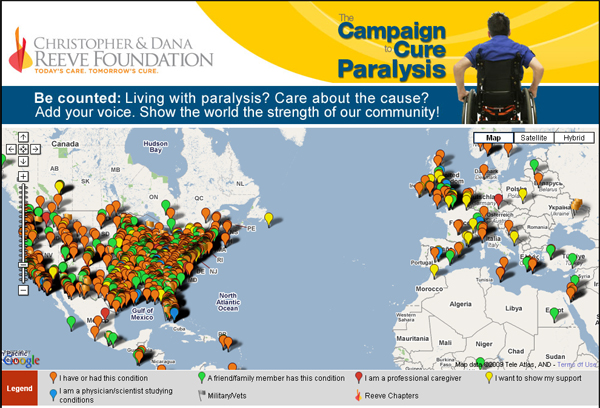
Map of paralysis community
An interactive map of the Americas, Europe and North Africa captured on 01.05.09. It shows different coloured flags representing people within the different groups of the ‘paralysis community’. Hundreds of flags are shown, the majority are orange, depicting people who have, or have had paralysis. Another very substantial group of flags are green, showing friends and family members. Flags of yellow, blue and red also punctuate the map, representing supporters, researchers and carers. The flags swarm across the eastern portion of the United States, with substantial numbers also running up the west coast and scattered in-between. Flags also speckle the rest of the world, indicating that this may be a North American campaign spreading slowly outwards. Over time the map will change as and when more people add themselves to the chart. Above the map are the Reeve Foundation logos and a banner reading 'Be Counted: Living with Paralysis? Care about the cause? Add you voice. Show the world the strength of our community!'.'

Yesterday I received an email about a new project that the Reeve Foundation have undertaken.

In short, the Foundation are creating a Google Map that (literally) maps what the Foundation calls the Paralysis Community. This project invites people who have, or have had this condition, friends and family, professional carers, supporters and researchers to map themselves into a global community. This looks to be getting a positive response, and, like today’s Blogging Against Disablism Day, it is a strong example of the ways in which Web 2.0 technologies can be harnessed to influence our understandings of disability.

In creating visibility and connections between people, this map raises the profile of a distributed community; as well as allowing people to literally put themselves on the map and create a reflection of their shared experience as a node within a collaborative network. Due to the visual nature of Google Maps, it is difficult to create an effective alternative format for this kind of project, a reminder of the contrary nature of some media. Furthermore, I think it would be difficult for an organisation that was not a trusted charity to engineer a mass disclosure of data of this kind. But, that said, this appears to be a bold project – embracing the affordances of mapping tools and pushing them to create new and positive self-determinations.

If you’d like to take part in the Reeve Foundation’s efforts to highlight this community, visit their website here: http://campaigntocureparalysis.org/

National Digital Inclusion Conference


select-all-keyboard-image
A 'select-all' key. A suitable metaphor for digital inclusion?

Earlier this week  (the 27th-28th of this month), the UK’s National Digital Inclusion Conference ’empowerment through technology;’ took place in Westminster, London.  Following on from their live feeds, 16 presentations including the keynote speakers are now available online. Speakers are largely governmental,  including Paul Murphy MP, Minister for Digital Inclusion, Sion Simon MP, Minister for Further Education and Lord Carter, Minister for Communications, Technology and Broadcasting, alongside representatives from the BBC, Wired and elsewhere.  I’m hoping to comb the video materials and cross reference them with AbilityNet‘s thoughts on Twitter for some steer on where to look.  I hope to post a digested read here reflecting any comment on Disability, Digital Divides and Higher Education in the next week or so.