Bill Gaver Seminar at MRL


This is a notice for a forthcoming event here at Nottingham University. On Monday 26th of January Bill Gaver, from Goldsmiths, University of London will be presenting his research as part of the Mixed Reality Lab visiting researcher lecture programme. Dr Gaver is Professor of Design and leader of the Interaction Research Studio at Goldsmiths, University of London and his presentation will focus on the dynamics of ageing. This researchshould be of particular interest to those interested in embodiment online.

HCT Seminars at Sussex University


*retroblogged*

On Friday 28th of November I presented my research at the Interact Lab at the University of Sussex as part of their HCT Seminar Series.  This was an interesting and enjoyable experience – and I highly recommend the group for presenters and attenders alike. The expertise of the audience proved invaluable for me. Aside from benefitting from the expertise of the Interact Lab and Informatics department, happily, my visit coincided with a visit from Henny Swan from Opera (accessibility blog GIANT iheni and formally Senior Web Accessibility Consultant at the RNIB) as well as Dr Christopher Douce, from the Open University, amongst others.  I'm hoping to attend future HCT seminars, where possible.

If you are interested in visiting the Interact Lab, seminars take place on Friday afternoons at 1.30pm
and last for an hour with coffee and cake available afterwards.
Speakers range from researchers at the cutting edge of their fields to
practitioners in industry. The seminars are intended for a general
audience interested in Human Computer Interaction;
interested students, or researchers in other fields, are always
welcome. They are an excellent way to learn more about recent trends,
ideas and results in HCI, learning technologies and related fields.

Universitas 21 Scholarship


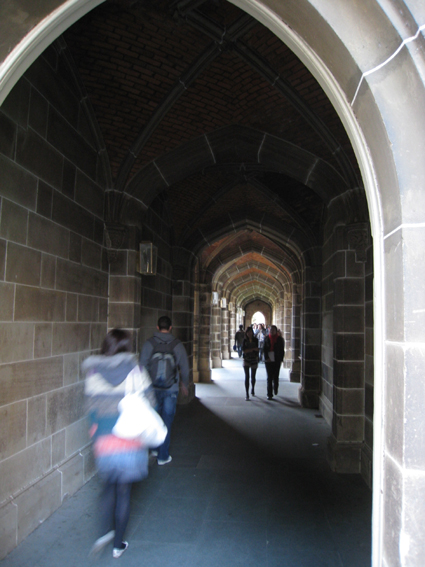
Melbourne University Quad
Students move through the dim stone archways of Melbourne University's Quad

As part of my ongoing debrief regarding the Universitas 21 Scholarship I undertook earlier this year I’ve been invited to talk at the first PGR Student Seminar this term, on Monday 1st December, from 12.30 – 1.30 pm.in Room B33, Dearing Building in the School of Education on Jubilee Campus. Refreshments will be available. These tend to be informal events focused on student perspectives. The blurb being circulated runs like this:

The speaker will be Sarah Lewthwaite who will be talking about Universitas 21. Sarah will talk about her experiences as a Universitas 21 visiting scholar at the Centre for the Study of Higher Education at the University of Melbourne, Australia. She will also discuss the application process for the U21 travel prize, and the practical aspects of making such a trip. If you are interested in applying for travel bursaries during the course of your studies, or finding out more about working internationally at other universities, this will be a ‘backstage’ look at how to get going!

I’ll be bringing along my application, as well as photos from the trip  – so if you think you’re interested in applying for this kind of scholarship in the future, do come along.

LSRI Seminar


LSRI Seminar Presentation

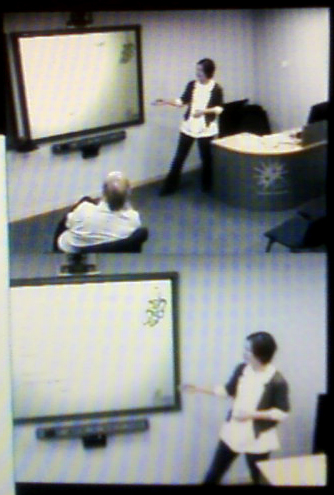
Thanks everyone who came along to my seminar at the LSRI yesterday, and to those who tuned in remotely! Thanks also to Dr Charles Crook, who chaired the session. If you missed the session, the video will be signposted from the LSRI Seminar pages when it becomes available. Pictured on the left is an image from the live video stream of the event. Two different angles on the room are presented, one wide angle, one close-up. If you’d like to request a copy of the slides, or anything else, please get in touch.

The Impossible Prison


At the end of October I went to the opening of the Impossible Prison, an exhibition curated by Alex Farquharson,  Director of Nottingham Contemporary. The exhibition is located within the Galleries of Justice Police Station, Nottingham, an atmospheric and provocative space in its own right.

16 international artists become ‘inmates’ in the Impossible Prison, inspired by Discipline and Punish, by Michel Foucault. The exhibition explores power, control and surveillance, increasingly a part of all our lives. The exhibition is free and runs until the 14th of December and comes highly recommended!

Those of you who scrutinise this blog regularly may recall a short piece I wrote about Mona Hatoum’s “Wheelchair” sculpture, a photo of which was used for the front cover of Tom Shakespeare’s book “Disability Rights and Wrongs”.  If you are interested in seeing Hatoum’s work first hand the Impossible Prison is a must. Her 1993 piece “Incommunicado” is exhibited in one of the Impossible Prison’s claustrophobic cells.  As with “Wheelchair” – this work attends to the institutional furniture of the hospital and home. To paraphrase the Tate (where an image of the sculpture can also be viewed):

“Incommunicado” is a bare steel sculpture made of an infant’s cot. The springs have been replaced by tautly stretched, fine cheese wire. The cold, hard, metal form of the cot has been honed down to its most bare and chilling structure. The potentially lethal wires anticipate acute pain. “Incommunicado” is a place where speech is no longer possible, a reminder of an infant’s inability to articulate its needs by any means other than a scream. It is also a metaphor for the plight of many political prisoners who are incarcerated and tortured in places where their voices cannot be heard. Here a relationship of ‘parent’ state to citizen-‘child’ is presented as cruel and abusive rather than warm and loving, murderous rather than nurturing.

I found this work and many others within the Impossible Prison very powerful. And, given the current turmoil surrounding the forthcoming extradition of Gary McKinnon to the United States, this exhibition will have strong resonance for some within Disability Studies.

A series of free Talks and Seminars have also been organised in conjunction with the exhibition.

  • Today (Monday 24th November 6 – 8 pm) Ken Starkey delivers the third talk in the series organised by Nottingham Contemporary – ‘Stranger in a Strange Land: Michel Foucault in the Business School’.
  • On Monday 3rd December, 6pm – 8pm, Eyal Weizman will talk about ‘The Architecture of Occupation in Israel.Palistine’.  Both talks will be given at Biocity, Nottingham.
  • Finally, Erwin James will talk about ‘Prison Today’ on Monday 8th of December at the Galleries of Justice themselves.

To book a place and to find out more about these events go to: www.nottinghamcontemporary.org.
Post Graduate Conference


*Retroblogged!*

Today was the first Post Graduate Conference in the School of Education for 5 years. "Weaving the Strands of Education Research" focusing on the intersects between policy, research and practice, saw 95 delegates converge on the Dearing Building, including UoN staff and students, and students from several other universities. The keynote address was delivered by Prof. Jerry Wellington of Sheffield University. I was pleased to be involved in organising the conference, in a role relating to access and technical support. From this vantage point I know how well the student organising committee have worked together and individually, striving for a great conference, chaired by Cheryl Rounsville. But even I have been surprised by how things have finally turned out.  The quality of the papers and the generally supportive and positive atmosphere have come solely from the student group. As Education is a post graduate department at Nottingham, shared lectures across the department do not happen. Research training and seminars from different research centres do occur, but only allow small groups of students to meet at any one time, this can mean that getting a sense of the department and peers research is difficult. In effect, I feel, as a delegate, that this has been an invaluable event, for networking but also for morale. Hopefully this conference can be taken forward in 2009. Photos and video from the event will be linked from here.

LSRI Opening


LSRI Labyrinth
The LSRI Labyrinth

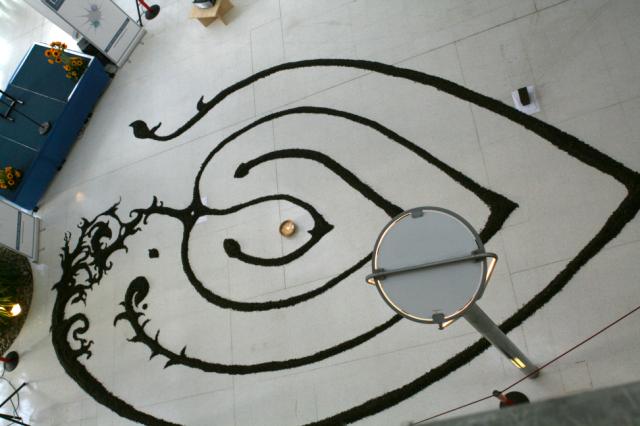
Friday the 7th of November was the happy occasion of the official opening of my research centre, the Learning Sciences Research Institute here at Nottingham. This was a great day including everything from project demonstrations, audio installations, video conferenced exchanges with the University of Nottingham’s Ning Bo campus, to cabinets of curiosities and the installation of Dr Matt McFall’s labyrinth (pictured above) laid out in the Exchange Building’s atrium.  The labyrinth is a path outlined in black in an organic shape close to a leaf or heart. The Institute was opened by Professor Roy Pea, co-director of H-Star (Human-Sciences and Technologies Advanced Research Institute) at Stamford University.  Professor Pea also gave a thought provoking keynote entitled ‘Fostering learning in the networked world’.  For those wishing to experience the event once more – photos are now available here.  I’ll add links to Prof. Pea’s presentation when it goes live, I’m certainly looking forward to a repeat viewing.

Research on Tour


Things have been seemingly very quiet here at 32 Days. This belies a flurry of activity behind the scenes. Firstly I’ve been doing a lot of interviews with Freshers here at Nottingham. Secondly there have been several events I’ve been to be involved in and attending – notably the official opening of the Learning Sciences Research Institute, the NTU Interactive Technologies Conference and recent workshop on Evaluation and Learning Spaces. I’ll be retro-blogging these and other events and linking back into October’s apparent void from here. Brace yourself. Other news includes some forthcoming seminars I’ll be giving:

  • Tuesday 25th November, 4pm @ Learning Sciences Research Institute, University of Nottingham.  This will be the first time I present to my peers here at the LSRI.
  • Friday 28th November, 1.30pm @ Human Centred Technology Research Group Seminar, University of Sussex.
    I’ll be very interested to find out more about the HCT group and its work. The HCT research group consists of two sub-groups; IDEAs lab and Interact lab. the IDEAs lab (Interactive Digital Educational Applications) encompasses the fields of artificial intelligence, education, cognitive science, psychology and computer science.  The Interact lab is focused on a user-centred approach to understanding and designing for interactions between people and technologies in everyday contexts.
  • Friday 5th December @ Liverpool John Moores University.
    In association with Liverpool John Moores University’s MA in Communication and Internet Studies ‘Critical Internet Studies’ Seminar Series, the Cultural Disability Studies Resarch Network (CDSRN) have organised this workshop entitled ‘Disability and the Internet: Access, Mediation, Representation’. This promises to be an extremely interesting day for anyone interested in the sociology of the internet and disability studies.

LSRI Opening Event


Today was the official opening of the Learning Sciences Research Institue. Reterospective photos and thoughts available here!

BSL Online Learning Support launched


At the start of the month I signed on to a CACDP course for a level one certificate in British Sign Language (BSL) at South Nottingham College. As anyone learning a sign language will know, paper notes can be difficult to revise from, so I anticipated hitting video materials online safe in the knowledge that we are all living in the future, I would find everything necessary to my personal advancement with the aid of the mighty YouTube. A bit naive?! Frankly, yes.

Although we may be living in the future (robot companions notwithstanding, DISCUSS), it quickly became clear that YouTube is not the place to rehearse your BSL. American Sign Language is, perhaps unsurprisingly, king, and even then using the search tool to hunt through the video archive for relevant vocabulary is increasingly like dowsing with a meat hammer. I was therefore delighted today to discover that CACDP has very recently launched an Online Learner Support Pack for BSL 101.

The Online Learner Support Pack is a free resource for everyone starting to do BSL101, and is a great way to help learners get off to a good start in learning British Sign Language.The Support Pack allows access to hundreds of videos of individual signs and sentences to help practising between classes, so if you have trouble remembering a sign, you can now go online to find and practise it instantly. Topics from BSL101 covered include the manual alphabet, numbers, transport, meeting people, weather, and directions.  As the internet becomes more mobile, I wonder if this can and will become the BSL pocket dictionary?

CACDP stress that this resource cannot be used to learn the complex language of BSL alone, as it is intended to only to compliment the methods of BSL teachers.  However, for those learning, or wishing to ‘Brush Up’ their British Sign Language skills, the online support materials are currently available to all, gratis.  To register visit: http://bslsupport.cacdp.org.uk/.