#2 ‘Identity and Disability’ by Nick Watson


The second post in my solo April blog festival.

WATSON, N. (2002) Well, I know this is going to sound very strange to you, but I don’t see myself as a disabled person: identity and disability. Disability & Society, 17, 5, 18.

Disability and Society

In March 2011 Aleks Krotoski, UK technology journalist and researcher wrote a piece about Disability and the Internet for the Observer. Although I recognised many of her arguments and observations, I disagreed with several key aspects of her analysis. In particular, her assertion that disabled people ‘pass’ as non-disabled online. Hers is a very blunt statement – and it is this concern, that disabled people who do not present themselves (or see themselves) as disabled online might in some way be complicit in maintaining, rather than challenging a disabling status quo that Watson’s research tears into.

Here Watson challenges a ‘passing’ interpretation of the actions of disabled people – presenting disabled people’s own accounts and identifying in the process an opposite interpretation, a political assertion of disability as normal. Watson’s research gives important nuance to this crucial area. For anyone writing, designing or researching disability and technology – this paper makes essential reading.

Note: My PhD explores this territory with respect to Social Networks. For an additional alternative reponse to Kotoski’s article, see how Ouch’s Disability Bitch goes into CyberSpasm

#1 ‘Aversive disablism: subtle prejudice toward disabled people’ by Mark Deal


To take advantage of Routledge’s free Education journal access over the course of April 2011, I’m presenting papers to highlight research with powerful applications in the fields of technology, disability and education. Comments and suggestions are, as always, welcome.

DEAL, M. (2007) Aversive disablism: subtle prejudice toward disabled people. Disability & Society, 22, 1, 14.

Disability and Society

Aversive Disablism is a little-known social phenomenon that exerts huge influence in the lives of people with disability. Deal’s paper highlights the importance of understanding and challenging this form of subtle disablism to ensure (amongst other aims) that design communities responsible for our built (or digital) environment do not perpetuate a society that actively disables people with impairments. In this sense, aversive disablism represents an important concept, without which any vocabulary of disability or design is incomplete. I drew on this paper for my 2010 Blogging Against Disablism post and Web4All joint paper with Brian Kelly and David Sloan last year, applying Deal’s arguments to incorporate online environments. Deal writes lucidly for a broad audience, as such this paper represents essential reading for all.

Further reading:

  • Consider Goggin and Newell’s groundbreaking 2003 book Digital Disability. This identifies the outcomes of web developer’s disregard for disabled users requirements  as “doing production”, resulting in a disabling web that enacts disability. The authors arguments are developed for contemporary Web 2.0 discourse by Ellis and Kent (2010) in their book Disability and New Media. Ellis and Kent develop this notion of “doing production” with regard to Social Networking Sites – their insights into the structural production of disability in social networks, I feel, resonates strongly with Deal’s notion of aversive disablism.

Next post out on Monday 4th.

Investigating Socio-Technical Experiences of Disability: Slides


Following on from my guest lecture at the Centre for Culture and Disability Studies (click for abstract) at Liverpool Hope University earlier this month, I’ve received a number of requests for my presentation slides. As a result, I’ve added them to SlideShare and made them more widely available below.  These slides are supplied with an important caveat, however. I designed the talk to balance descriptions of what worked and what didn’t work over the course of my PhD research; I also talked a great deal around the slides – that means that important content and context is missing in several areas. Nonetheless, I think the literature cited, methods overview and some of the results reported will be of interest to researchers and others in the field. If you require an alternative format, please don’t hesitate to get in touch.


30 Days of Academia: Your Guide to Routledge in April 2011


Over the course of April, Routledge are giving free open access to all Education journals, with no academic subscription or institutional affiliation necessary and no strings attached.  The Routledge stable includes some mighty journals for those involved in Technology, Disability and Education, including Disability and Society, the Scandinavian Journal of Disability Research and Studies in Higher Education. Together, these journals and their peers offer access to hundreds of pieces of groundbreaking research.

To celebrate, from Friday April 1st onwards, I will introduce and link a selection of papers that have been hugely influential in developing and challenging my thinking on disability, technology and education. This curated compilation represents a guided tour of some of Routledge’s ‘Greatest Hits’, to inform readers outside universities (in particular, techies, geeks, accessibility professionals, and others) and, I hope, help open up and apply disability theory and digital inclusion research for debate amongst new audiences. The list will also have relevance for scholars and academics in the field, and those whose universities do not currently subscribe to these journals (for example, my own institution, the University of Nottingham, does not supply access to the Scandinavian Journal of Disability Research, I have my associate lectureship at Sheffield Hallam to thank for this particular literature hack!).

So, over the course of April I invite you to join me as I introduce each paper. You can subscribe to the blog to receive an alert via RSS feed or email when each post goes live, or simply drop by in over the course of the month and see what my suggested bibliography has to offer. If you are considering compiling a similar list in conjunction with Routledge’s Education free-for-all, be sure to signpost below. Comments and suggestions are welcome!

Page Numbering for Your Thesis


Tips for thesis-making: the first in an occasional series.

Your university or department will supply specific guidance on page formatting and the presentation of the thesis, but in my experience (and the experience of PhD students around me) finding the information on how to achieve correct presentation of a thesis using Word is surprisingly difficult, as is remembering the process once you’ve worked it out. In particular, issues of page numbering (sounds simple: it isn’t) and combining separate chapter documents whilst maintaining/generating Endnote references without duplication (sounds complicated: it is) can add hours to tight submission timescales. In this first post I address page numbering. This is not a beginners guide to Word. This is aimed at people with reasonable proficiency.

I know what you want to do. You have combined all of your chapters and additional appendices, abstract etc into one document. You have saved the thesis file. You have backed up the file, diligently, in a million different places. You now need a Title page without numbering, the following pages (your acknowledgements, abstract, table of contents, table of figures) require Roman Numerals, your thesis then begins on what needs to be Page 1, the first page of your first chapter and run throughout the remainder of this substantial document. Of course you know what you want do to. Now we just have to get Word to do your bidding.

First, remove any pre-standing page numbers from your document. Next, on the Home menu, go to the Paragraph section and select Show/Hide Formatting button (to ‘show paragraph marks and other hidden formatting symbols’). This will allow us to see the formatting interventions we are about to make. 

A Word Menu is shown with the Show Formatting button highlighed

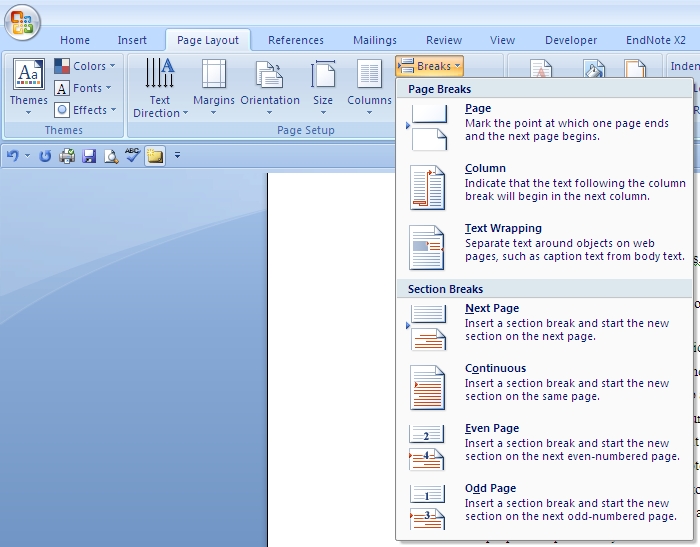
The next step is to insert a Section Break between the early pages of your thesis and what will be Chapter 1 Page 1. The Section Break is the key. In Word 2007 (my current edition) the section break is found on the Page Layout menu as ‘Breaks’. Firstly, make sure you have selected the area where you wish the page numbers to be differentiated (the page before Chapter1). Now, go to Page Layout > Breaks. It has a sub menu (pictured) containing Page Break options and Section Break options. Select “Next Page: Insert a section break and start the new section on the next page”. The Section Break may alter formatting around it. Keep the section break and make whatever changes need to be made to keep everything else in its place.

Page Layout menu shown with Breaks submenu and Section Break option

 Now we add the numbers. Above the Section Break, select the Insert menu. From there, click next to Page Number to access the Page Number Menu. Select “Format Page Number”. In the box marked “Page Number Format” select your preferred numbering for the opening pages of your thesis.

Next, with your cursor still in the opening section of your thesis, insert page numbers in the usual way. This should give you your desired numbering for the opening sections of the thesis.

To add usual numbering to the main part of the document you need to return to the Page Numbering menu. Select “Format Page Number”. In the box marked “Page Number Format” select your preferred numbering for the remaining pages of your thesis.
Move your cursor to a section of the thesis after your Section Break (where usual numbering is intended). Now insert page numbers in the usual way. At this point you should have number i, ii, iii, iv, through to 1, 2, 3, 4, for the whole document.

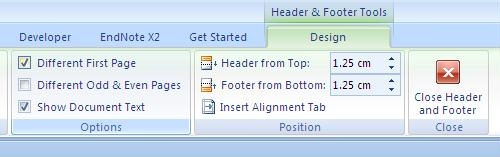
But what about your title page? This is currently page i, and it doesn’t look great. Click your mouse in the footer of the first page. A new Design menu is activated at the top of the Word window (pictured). In the Design menu, go to the Options sub menu, and tick the box marked “different first page”. This will remove the number from your title page.

The Design menu is shown with the
The Design menu is shown under the Header and Footer Tools tab. From here the Different First Page can be selected.

Congratulations, you’re done! If you have an automatically generated Table of Contents, update it now to see the results.

Event: Investigating Socio-Technical Experiences of Disability in Social Media.


On the 8th March 2011 from 4-6pm I will be presenting my doctoral research to researchers and students at Liverpool Hope University’s Centre for Culture and Disability Studies in the Faculty of Education. This guest lecture is offered as part of ‘Introduction to Research Methods: Disability Studies’.  If you would like to attend, please contact the CCDR’s Deputy Director Dr. Ria Cheyne via cheyner@hope.ac.uk.  More details about the location, slides and so forth will be added closer to the day. I hope to see you there!

Title: Disability 2.0: Investigating Socio-Technical Experiences of Disability in Social Media.

Abstract: For many young people, social networks are an essential part of their student experience. My research explores disabled students experiences of disability in social networks to understand how dis/ability difference is ascribed and negotiated within such networks, and the impact it has on student life. This research is firmly located within the social sciences, drawing on the thinking of Foucault to develop understandings of disability and power relations online. However, its research object, the socio-technical mediation of disability, is interdisciplinary; drawing on research territories that are unfamiliar to many disability studies researchers.

 In this talk, I give a backstage look at negotiating a path through interdisciplinary disability studies research, touching on information sciences and human computer interaction, and the particular problems and opportunities that this kind of activity presents. I introduce the notion of ‘bricolage’ as a user-friendly multi-perspective methodology and research approach that has enabled me to develop new, technology-enhanced and accessible research methods, and develop a research lens drawing on complementary methods from Activity Theory, Phenomenography, Discourse Analysis and Case Study.

This will be an interactive session aimed at researchers and students. Prior knowledge of the methods and technologies presented is not necessary. Following on from an orientation in social media research for disability studies, I will also talk about the findings of my research, which consider the ways in which social technologies reposition disabled people within taxonomies of identity, enabling some and dis-abling others.

Who is Researching Disability in Facebook?


This is my first post of 2011, I’d really appreciate your thoughts to develop these arguments. Comments, as ever, are welcome!

At New Year I met some new people and began explaining my PhD research into Disability and Social Networks (no doubt more technically and tediously than my audience had hoped). In the following discussion a ‘disability’ vignette came up. A reveller described how a colleague at work was currently out of the office sporadically, due to anxiety. She was signed off work on grounds of stress. However, word had spread around the office that, despite the leaves of absence being taken, this person had posted several upbeat messages on Facebook over weekends, including photos from parties and other social events. Others in the office were beginning to question the reality of her mental health on this basis.

My own research highlights how the boundaries of disability shift in social networks, as disability and ability are ascribed and mediated by peers, tools and the social context. To me, this vignette highlights the complexity of disability and its representation online, alongside some worrying developments in disability-surveillance.

Research into Facebook highlights powerful social norms that are enacted in social media due to context-collapse. Importantly, Facebook in particular, is an upbeat space where users present their ‘best’ self for scrutiny before a mixed audience of friends, family, associates etc; lots of different contexts are collapsed into one. As a result, many people upload their only best (sometimes airbrushed) photos, comment with only their wittiest witticisms and so on. This instigates a powerful norm of ingratiation. In research interviews, the disabled students I spoke to repeatedly stated that Facebook was not a place to publicly express depression or serious mental illness. Indeed, for some, the only signifier of such disabilities in networked publics was silence, a lack of interaction resulting in greater isolation. Such silences may be noticed by attentive friends, however, as we will see, to insurers and employers, it is noise, not silence, that attracts the most attention.

Somehow, Facebook interactions known to be private and frivolous, have become caught up in a legal and corporate project to define how much disability is required to qualify as disabled. In these terms, Facebook is conveniently identified as the inside track, the Truth of what is going on. Within this, any number of assumptions about what constitutes a disability are enacted. More importantly, an underlying concern can be perceived regarding the force with which the boundaries are decided without reflection. I would argue that these moves ‘discipline’ disabled people. In this way, disabled people must perform a strictly defined role. The abilities of a disabled person are rendered suspect: and, according to this view, there is nothing more offensive than a disabled person who is not disabled, or not disabled enough. Within this dichotomy there is no room for grey areas, i.e. the complexity and diversity of impairments that exist in day to day life. Grey areas are difficult; it is much easier to render these issues in cartoonish black and white.

A recently example comes from the Chicago Tribune (also printed in the LA Times).  The Tibune highlight how insurers are looking to Facebook for evidence to challenge claims.

If someone receiving disability benefits for a bad back brags on Facebook or Twitter about finishing a marathon, chances are their insurance company will find out and stop the cheques.

Chicago Tribune

The newspaper leads with an extreme example, the ‘person with a bad back’ signed off work, who then posts to Facebook that they have completed a marathon.  This vignette is offered as the quintessential disability con.  Underneath this headline, however, any number of more complex cases cascade; including the mundane case of the person experiencing anxiety attacks, signed sporadically on and off work and but maintaining a social life. Expressing such a life in Facebook is important – to challenge stigma and resist isolation. However, whilst employers and insurers stalk the network, I’m concerned that users will be forced to choose between performing Normal according to non-disabled network norms OR performing the externally defined role of the Disabled Person. Increasingly, physical or cognitive impairment has nothing to do with it.
Viva Result: Minor Corrections


Great news! On Monday morning I completed my Doctoral Viva – the examination of my PhD thesis “Disability 2.0: Student dis/Connections. A study of student experiences of disability and social networks on campus in Higher Education.” My examiners were accessibility, disability and education expert Prof. Jane Seale (Plymouth University) and identity and methods specialist Dr Kay Hawe (University of Nottingham).

I’m pleased to report that my research exploring students’ experiences of the socio-cultural aspects of disability in social networks has been accepted, and I have been awarded my PhD pending minor corrections. I will complete these corrections over the next three months. Huge thanks go out to everyone involved, especially my supervisors, Dr Charles Crook and Dr Gordon Joyes.

If you would like more information about my research in advance of the publications of the thesis and related documents, please get in touch with me directly via ttxsem@nottingham.ac.uk.

Hack is a Feminist Issue


Tomorrow (Tuesday November 9th),  the Learning Sciences Research Institute here at Nottingham University is having an Open Day. Within this are a schedule of talks including my own short presentation on bricolage and interdisciplinary working. I make my presentation at 9.30am, following Dr Charles Crook and Prof. Mike Sharples. 

In this short presentation I will talk about the realities of articulating digital research in the field. Increasingly new digital tools and media are available to researchers, each offering a new affordance in terms of data collection. These can emerge over the course of a PhD project. The pragmatics of research mean that we may often draw on such tools, however, there appears to be a tension between this apparently pick-and-mix approach and the wider theoretical demands of methodology grounded in a particular paradigm, discipline or theory. This is not a new problem, this sort of ‘hacking’ for research purposes has theoretical lineage in sociology, where it is known as bricolage. Viewing research hacking activities through this sociological lens exposes the value of bricolage as an agile, economical, interdisciplinary, feminist and anti-hegemonic undertaking. Using examples from accessibility and my own digital disability research, I introduce and recommend bricolage as the Swiss-Army Knife of research approaches. 

Disability Research Forum


Two pieces of news today. Firstly, on September 30th I submitted my PhD thesis “Disability 2.0: Student dis/Connections. A study of student experiences of disability and social networks on campus in Higher Education”. As a result, from this point forward I will be showing my blog a little more TLC. However, my second piece of news may distract you from a revived and refreshed 32 Days Remaining! The all *NEW* Disability Research Forum blog now also vies for your attention. I heartily recommend the DRF blog to you for UK disability research news and updates on the Research Forum’s own activities. They are always welcoming to new members, so if you want to present, lead a discussion or simply participate from afar, the blog is a great place to start.