Tagged: Disability

Digital Election Special


Yesterday Alex Watson (@Sifter) published Use the Internet to Decide How to Vote on bit-tech. The article identifies various resources, from checking your voter status at 192.com to researching your current MP at They Work For You.

With less than 24 hours till polling, this post is a little late, but I’d like to highlight a couple of excellent resources the have emerging from digital accessibility communities via Twitter.

First up, consider the excellent work by Elena Newly (via Twitter @AutismWales) who has worked to provide Easy-Read summaries of all the political Parties’ manifestos. These Easy-Read documents are designed for learning disabled adults and those involved with the LD community. She has also created an Easy-Read Summary of the second TV Leaders’ Debate.

Secondly, consider the election resources available from the British Sign Language Broadcasting Trust . This has included a schedule of signed programmes and two key Election broadcasts available online:

The first election special deals with the voting process.

The second election special ‘Your Country Needs You’ focuses on making an informed decision.

If you know of other digital resources I’ve missed, please add a comment below.

A Chair is a Wheelchair


This Spring I’m pleased to say I’ll be teaching as an Associate Lecturer at Sheffield Hallam University as part of their BA (Hons) programme in Education and Disability Studies. From January onwards I’m teaching Exploring Disability History. This has given me a great excuse to engage with new literature and research, alongside revisiting papers and materials. If you’ve visited this blog before, you’ll know my writing usually focuses strongly on disability, technology and accessibility issues, with some broader references to my experiences of the PhD process and Educational Technology. However, the teaching preparation has already set off various different chains of thought which I hope to explore here over the next few weeks. My first tidbit is an unpublished poem by Tanja Muster ‘A Chair is a Wheelchair’ translated from German and reproduced in ‘The ADA on the Road: Disability Rights in Germany’ by Katharina C. Heyer (University of Hawai’i). I’ve reproduced the poem below in both English and the original German.

A Chair is a Wheelchair

A chair
looking carefully
A chair is a chair is a
wheelchair
A judgement is a judgement is a
mis-judgment (prejudice)
A disability is a disability is a
State-sponsored measure.

Ein Stuhl ist ein Rollstuhl

Ein Stuhl
Genau besehen
Ein Stuhl is ein Stuhl ist ein
Rollstuhl
Ein Urteil ist ein Urteil ist ein
Vorurteil
Eine Behinderung ist eine Behinderung ist eine
staatlich geforderte Massnahme.

According to Heyer:

This poem circulated in German disability circles in the fall of 1997 as an expression of outrage against Germany’s Federal Constitutional Court’s October 29 ruling that disabled students do not have a right to an integrated education and may be forced to attend a special school for disabled children (Bundesverfassungsgericht, 9 October, 1997).

I found the title particularly striking. For me ‘A Chair Is A Wheelchair’ is the most succinct expression of disability as a continuum I’ve come across. I find the poem deceptively simple.  In English, the writer very playfully sets up ‘norms’ and then inverts them alternately line by line. But with each inversion the poem progresses and deepens.  This progression moves from the cultural norm (the regular Chair becoming the irregular Wheelchair) to the legal norm (now exposing a regular and normal legislature as, in fact, failing and prejudiced) to return to the notion of disability, this time invested with normalcy, inverted and made irregular by the State.  In each case, I love how the repetition physically installs a ‘mainstream’ in the poem, whilst simultaneously moving the reader across a spectrum of perspectives.

Accessibility and Hierarchies of Impairment


Following on from yesterday’s MRL lecture, I was fortunate to talk with Prof. Dame Wendy Hall about my research and a short paper I’ve written on ‘Aversive Disablism and the Internet’, borne out of Blogging Against Disablism Day. This paper has been accepted for the 1st Symposium for Humanities and Technology Interface 2009, at the University of Southampton in July. The Symposium looks to explore many of the themes of Web Science advocated by Dame Wendy and other Soton and MIT colleagues, alongside more diverse interdisciplinary projects.

Interface requires that all delegates present either a Lightning Talk of 2 minutes, or a poster presentation.  I’ve pulled on my size 6.5 Lightning Boots, and opted for the former presentation style – and in conversation with Dame Wendy had a chance to rehearse my pitch on aversive disablism and it’s relevance for advancing debate and action on digital inclusion. Professor Hall immediately related this notion back to W3C web standards and asked my view on this – was I stating that (dis)ablism occurred at this level?  This turned the conversation to hierarchies of impairment.

Within accessibility practice (as in many other spheres) research and resources frequently prioritise certain communities and their requirements above others for a nexus of reasons.  In brief terms, hierarchical views of disability and impairment have been researched since the 1970s, but in 2003, Deal published Disabled people’s attitudes toward other impairment groups: a hierarchy of impairments (Disability & Society,18:7,897-910) to explore potential inter-group discrimination amongst disabled people.  Deal’s thorough review of the literature relating hierarchic understandings of impairment by both disabled and non-disabled people is essential reading.  Deal concludes with a call for research in this area, and notes that:

…it is important that, whilst disabled people fight a common cause in seeking equality within society and the removal of discriminatory practices, strategies for attitude change are targeted in a manner that makes them most effective. This may include focusing attention on impairment groups that face the most discrimination in society (i.e. those ranked lowest in the hierarchy of impairments), rather than viewing disabled people as a homogenous group.

Deal’s later PhD research explores the nuances of this hierarchy. His thesis Attitudes of Disabled People Toward Other Disabled People and Impairment Groups from 2006 can be found hosted at the Enham Research pages.

When relating these sociological frameworks to the internet, there is no doubt that, in pro-disabled accessibility discourse, certain groups are privileged above others. Whilst there is increasing sensitivity to this in Computer Science, with developers and researchers working to close the distance, this reasons for this divide are under-theorised within ICT discourse.

Much accessibility research focuses strongly on achieving accessibility for people with mobility, sensory and some text impairments – this is clearly important work, however, it does not represent the totality of necessary accessible practice.  For example, when Brian Kelly and others cited limits to the W3Cs Web Accessibility Initiative in their paper 2007 Accessibility 2.0: People, policies and processes they upheld Joe Clarke’s observation that the WACG development process lacked adequate provision for users with cognitive disabilities and learning difficulties.  Kelly et al also cited Lisa Seeman’s formal objection to WCAG 2.0, requesting that implicit claims that the guidelines did cover cognitive disabilities be omitted from the guidelines’ abstract altogether.  I would argue that this is one example of an occassion where cognitive and learning disablities have been afforded lower status in development discourse history and suffered aversive disablist outcomes as a result.

Clearly, accessible practise contends with the grey areas of potentially conflicting subjectivities. But viewed in light of Deal’s call to arms; adopting theory and strategies emergent from disability studies in the heart of mainstream internet practice would, I feel, create stronger debate pushing foward positive outcomes for all disabled people.  Is this a matter for a ‘Disability Web Science’?
Interactive Technologies and Games Conference: Education, Health and Disability


Last year I was part of the organisational committee for the first Interactive Technologies: Education, Rehabilitation and Disability conference at Nottingham Trent University. The conference now enters its second year, with strengthening ties to the Game City festival and a view to a special edition of Computers and Education in 2010.

The conference aims to bring together academics and practitioners to showcase practice and to show how research ideas and outcomes can be mainstreamed. It will introduce a wider audience to key findings and products from research and will illustrate how practice feeds back into and informs research. Joint academic-practitioner papers are welcomed; the conference will create a forum for two-way communication between the academic and practitioner communities.

This years’ conference, titled ‘Interactive Technologies and Games: Education, Health and Disability’ will be held at NTU in Nottingham on 27th October 2009.  If you’re interested in attending, exhibiting or presenting at the conference, the important dates have been released with the call for papers. This is a Word Document and opens in a new window.

The deadline for submissions is Friday 26th June 2009.  There is a conference fee of £60 (concessions £30). I’ll add details of the Conference website as these are confirmed. For those specifically interested in the Disability Strand, topics to be covered (but not limited to) include:

  • Approaches to making Virtual Environments (VE), computer and video games accessible by all
  • Assistive technologies for people with disabilities and elderly people
  • Practical applications of VE and serious games for the education of people with disabilities and elderly people (in e.g. work preparation, travel training)
  • Location based services for navigation and reconnection of people with disabilities
  • Art and music rehabilitation in 3D multisensory environments
  • The engagement potential of serious games for young people at risk of social exclusion (e.g., offenders, those with learning disabilities)
  • Design for All
  • Including people with disabilities in the design of serious games, assistive technologies and VE.

Using Google Maps to Map Communities with Disabilities


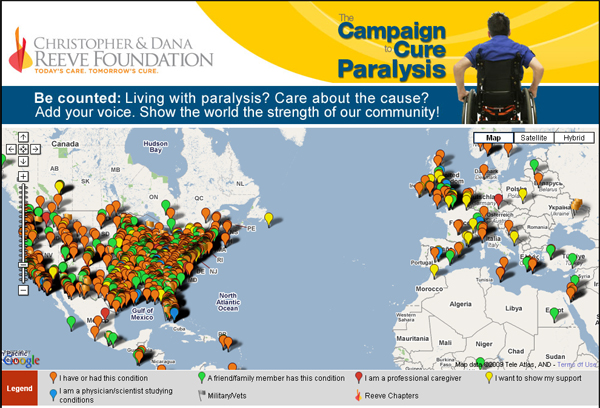
Map of paralysis community
An interactive map of the Americas, Europe and North Africa captured on 01.05.09. It shows different coloured flags representing people within the different groups of the ‘paralysis community’. Hundreds of flags are shown, the majority are orange, depicting people who have, or have had paralysis. Another very substantial group of flags are green, showing friends and family members. Flags of yellow, blue and red also punctuate the map, representing supporters, researchers and carers. The flags swarm across the eastern portion of the United States, with substantial numbers also running up the west coast and scattered in-between. Flags also speckle the rest of the world, indicating that this may be a North American campaign spreading slowly outwards. Over time the map will change as and when more people add themselves to the chart. Above the map are the Reeve Foundation logos and a banner reading 'Be Counted: Living with Paralysis? Care about the cause? Add you voice. Show the world the strength of our community!'.'

Yesterday I received an email about a new project that the Reeve Foundation have undertaken.

In short, the Foundation are creating a Google Map that (literally) maps what the Foundation calls the Paralysis Community. This project invites people who have, or have had this condition, friends and family, professional carers, supporters and researchers to map themselves into a global community. This looks to be getting a positive response, and, like today’s Blogging Against Disablism Day, it is a strong example of the ways in which Web 2.0 technologies can be harnessed to influence our understandings of disability.

In creating visibility and connections between people, this map raises the profile of a distributed community; as well as allowing people to literally put themselves on the map and create a reflection of their shared experience as a node within a collaborative network. Due to the visual nature of Google Maps, it is difficult to create an effective alternative format for this kind of project, a reminder of the contrary nature of some media. Furthermore, I think it would be difficult for an organisation that was not a trusted charity to engineer a mass disclosure of data of this kind. But, that said, this appears to be a bold project – embracing the affordances of mapping tools and pushing them to create new and positive self-determinations.

If you’d like to take part in the Reeve Foundation’s efforts to highlight this community, visit their website here: http://campaigntocureparalysis.org/