Yesterday I received an email from the Ann Craft Trust, a national UK charity which works to protect disabled children and adults with learning disabilities from abuse.
The Trust undertake vital work, as recent studies have shown that around 60% of adults with learning disabilities have experienced abuse at some point in their lives. There is also strong evidence that disabled children are significantly more likely to be abused than children who are not disabled.
The charity is looking for a web developer with the time and accessible web skills to do a piece of voluntary work, redesigning their website. This will involve creating a new template to tie in with the charity’s new branding. Visit the current Ann Craft Trust website to find out more about the charity and its work.
If you are interested or think you can help, please contact Charlie Heywood the Marketing and Development Officer for the Ann Craft Trust via Charlotte.Heywood@nottingham.ac.uk . Please copy and paste or forward this call to your networks.
<div class=”float-quote alignright”><a href=”http://www.robobraille.org/frontpage”>Robobraille</a> is a free ‘phenomenally powerful resource’. Users send a word processed document to an email address, the document is returned in DAISY format. DAISY, the Digital Accessible Information System, is a format for digital audio books for people who wish to hear and navigate written material presented in an audible format.</div>
This Spring I’m pleased to say I’ll be teaching as an Associate Lecturer at Sheffield Hallam University as part of their BA (Hons) programme in Education and Disability Studies. From January onwards I’m teaching Exploring Disability History. This has given me a great excuse to engage with new literature and research, alongside revisiting papers and materials. If you’ve visited this blog before, you’ll know my writing usually focuses strongly on disability, technology and accessibility issues, with some broader references to my experiences of the PhD process and Educational Technology. However, the teaching preparation has already set off various different chains of thought which I hope to explore here over the next few weeks. My first tidbit is an unpublished poem by Tanja Muster ‘A Chair is a Wheelchair’ translated from German and reproduced in ‘The ADA on the Road: Disability Rights in Germany’ by Katharina C. Heyer (University of Hawai’i). I’ve reproduced the poem below in both English and the original German.
A Chair is a Wheelchair
A chair
looking carefully
A chair is a chair is a
wheelchair
A judgement is a judgement is a
mis-judgment (prejudice)
A disability is a disability is a
State-sponsored measure.
Ein Stuhl ist ein Rollstuhl
Ein Stuhl
Genau besehen
Ein Stuhl is ein Stuhl ist ein
Rollstuhl
Ein Urteil ist ein Urteil ist ein
Vorurteil
Eine Behinderung ist eine Behinderung ist eine
staatlich geforderte Massnahme.
According to Heyer:
This poem circulated in German disability circles in the fall of 1997 as an expression of outrage against Germany’s Federal Constitutional Court’s October 29 ruling that disabled students do not have a right to an integrated education and may be forced to attend a special school for disabled children (Bundesverfassungsgericht, 9 October, 1997).
I found the title particularly striking. For me ‘A Chair Is A Wheelchair’ is the most succinct expression of disability as a continuum I’ve come across. I find the poem deceptively simple. In English, the writer very playfully sets up ‘norms’ and then inverts them alternately line by line. But with each inversion the poem progresses and deepens. This progression moves from the cultural norm (the regular Chair becoming the irregular Wheelchair) to the legal norm (now exposing a regular and normal legislature as, in fact, failing and prejudiced) to return to the notion of disability, this time invested with normalcy, inverted and made irregular by the State. In each case, I love how the repetition physically installs a ‘mainstream’ in the poem, whilst simultaneously moving the reader across a spectrum of perspectives.
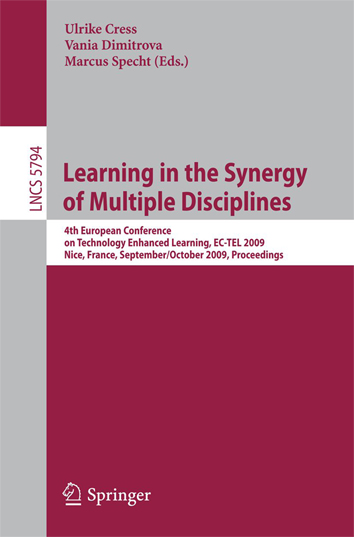
Cover of 'Learning in the Synergy of Multiple Disciplines'
‘Learning in the Synergy of Multiple Disciplines’, the proceedings of the 4th European Conference on Technology Enhanced Learning are now available via Google Books (free, but with some pages omitted) and in hardcopy and PDF Chapter by Chapter with publisher Springer. The collected papers were edited by volume editors, Ulrike Cress, Vania Dimitrova and Marcus Specht. Additional reviewers include myself, Liz Brown, Stamatina Anastopolou and Zoe Hadley from the Learning Sciences Research Institute at the University of Nottingham (amongst others).
Springer describe the book as constituting the refereed proceedings of the 4th European Conference on Technology Enhanced Learning, EC-TEL 2009, held in Nice, France in September/October 2009. The 35 revised full papers, 17 short papers, and 35 posters presented were carefully reviewed and selected from 136 paper submissions and 22 poster submissions. The papers are organized in topical sections on adaptation and personalization, interoperability, semantic Web, Web 2.0., data mining and social networks, collaboration and social knowledge construction, learning communities and communities of practice, learning contexts, problem and project-based learning, inquiry, learning, learning design, motivation, engagement, learning games, and human factors and evaluation.
Next week I’ll be opening a round table discussion at Sheffield Hallam’s Disability Research Forum (DRF) on ‘Defining Disability’, specifically I hope this session will help us understand what the process of definition itself does to our understanding. As always, the DRF is free to attend, so if you’re interested participating you’re very welcome. The location is easily accessible and very close to the central station. My session follows a presentation by Graham Grace-Gardener (Sheffield Hallam University) entitled ‘Is universal educational inclusion desirable and/or possible?’. Abstracts are detailed below.
Monday 7th December 2009: 2pm-4pm (Arundel Building 10111, Sheffield Hallam University, Sheffield)
‘Is universal educational inclusion desirable and/or possible?’ Paper presentation by Graham Grace-Gardener (Sheffield Hallam University)
The Inclusive Education agenda has hit the hard places, how do we include the children at the extremes of acting out behaviour or those who have severe learning difficulties? Is universal inclusion possible? Is it desirable? Who makes these decisions? What informs these decisions? Can universal inclusion be obtained in a late capitalist post-welfare society? This paper will be a socio-political discussion of the inclusion agenda informed by the work of Herbert Marcuse. It will try to address whether a one dimensional view of the world, reinforced by globalisation, precludes the change needed to bring about universal inclusive education? The session will be an informal sharing of initial thoughts around these points.
‘Defining Disability: Using Taxonomies and Facets to understand what categories and definitions do’ Roundtable Discussion led by Sarah Lewthwaite (University of Nottingham)
Governments, legislation and models of disability and each advocate a certain perspective on impairment and disability. Each of these defines disability in its own way, with powerful effects on the lives of disabled people. In this open discussion I would like to introduce some developments from Information Architecture on the problem of category-making and definition to shed light on how definitions work.
Foucault (1966) identified the ‘invisible power’ of categories, however Bowker and Star (1999) observe that critical discourse has not pursued this analysis. Whilst dominant definitions are challenged and negotiated, the nature of categorisation and its influence is not fully understood. I hope that, during a formative discussion, we can evaluate and identify potentially new approaches to defining disability within research and teaching.
I’ve just received notice via the Association for Learning Technology that the first two chapters of Dr Jane Seale’s Teaching and Learning Research Programme -Technology Enhanced Learning (TLRP-TEL) commentary on Digital Inclusion are now available to view online.
Interested individuals are invited to add their comments and opinions on the online version of the commentary. These comments will then inform the writing of the final published document. For more information and to get involved go to:
Following reviews from others working in accessibility, inclusion and Higher Education, I’ve been watching footage from the recent Handheld Learning Conference in London. Extensive online proceedings including video are available on the conference website and via iTunes.
I’ve supplied links to videos alongside notes on the first 5 presentations from the Inclusion Session below. Notes from Sal Cooke’s presentation are most complete due to the range of sources she draws on and my own interest in the projects she cites. For brevity, this a descriptive account, not an analytic one. As I did not attend the conference myself, comments are very welcome. Please note all links open in a new window and many presentations feature slides that are not audio-described.
I recommend a listen to Clark’s introduction, which he also outlines in his blog article ‘Handheld Learning: Malcolm Maclaren et al.’ Clark poses provocative questions to delegates:
To what problem is ‘inclusion’ an answer? Doesn’t everyone have a mobile?
Is ‘Digital Divide’ an outmoded term? It’s no longer a poor/rich divide, but a series of fractures.
Specifically, here Clark identifies a disjuncture in the UK between ‘analogue’ educational practices in schools and the ‘digital’ world that characterises nearly everything else.
Can inclusion actually result in exclusion? The fact that the few don’t have the technology means the many don’t get anything.
In terms of accessibility discourse, I feel this relates to the observations made by Brian Kelly and others regarding the development of Adaptable and Accessible practices. Video and other media from Brian’s presentation at TechShare are available via his blog.
Has the ‘Digital Britain’ report helped or hindered our digital future? It’s largely about TV, Radio and Newspapers or punishing file-sharers.
Clark also questions policy approaches, making a strong critique of Digital Britain, identifying how a scoping document has become a punitive exercise.
Speaker 1: Niel McLean: ‘Inclusion: The Home Access Story’ (video) 20 minute talk and 5 minutes of questions. Note: This presentation opens with brief use of Russian in an illustrative point at the start of the talk.
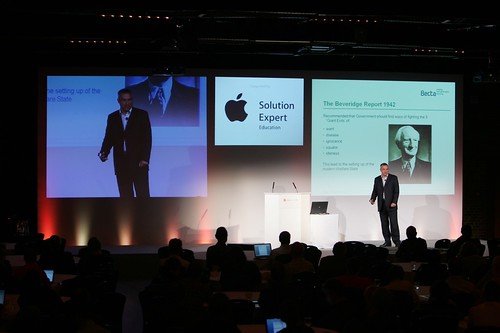
Niel McLean presents in front of a slide on the Beveridge Report of 1942
Niel McLean is Executive Director of Becta (the British Education and Communications Technology Agency), here he introduces the Home Access project which seeks to ensure that all pupils in state education in England have the opportunity access to computers and internet connectivity for education at home. The programme supplies funding to achieve this. Aside from McLean’s discussion of socio-economic deprivation as a distinct category within the inclusion agenda, this talk includes a valuable dissection of the political grounds for Government’s role in ensuring home-based access to education.
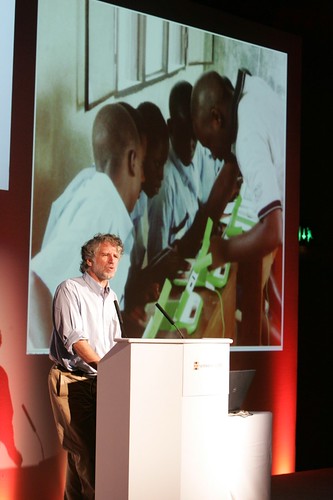
David Cavallo presents infront of an image of five boys with laptops in an African classroom
David Cavello is the Chief Learning Architect at MIT on the One Laptop Per Child project. One Laptop Per Child is a renowned project that aims to create educational opportunities for the world’s poorest children by providing each child with a rugged, low-cost, low-power, connected laptop with content and software designed for learning. Cavallo is a charismatic speaker and news on the progress of the project is always engaging (as is Dr Sugata Mitra’s Hole in the Wall project in India). Questions and answers relate to bandwidth, collaboration and infrastructure.
Hayes’ focuses on gender and games based learning, reporting the educational implications bourne out of non-traditional gamers (middle-aged women) approaches to game design and ‘modding’ The Sims.
Cooke’s presentation focuses on mobile device research and relations to inclusion, disability and Special Educational Needs in a wide-ranging talk that draws on multiple projects and resources. She begins by reporting recent ministerial announcements about mobile devices in Education. These include: Funding for 118 projects, 30 significant case studies with 8 to be studied in-depth to examine impact. Projects will particularly focus on:
Field Work, Special Needs, home access, staff and learner capacity
Innovation in the curriculum
Motivation of the learner, particularly the disengaged
Measures of significant improvements in learning outcomes
However, she quickly moves on to point out that much of this research has arguably already happened. Specifically, the ‘Portables in Action’ NCET Project reported outcomes in 1994 and concluded at that time that:
“Educational achievements are enhanced by pupils using portable computers, including the volume and quality of their work, particularly in accuracy and standard of presentation”
“there is clearly a great potential for using portable with special educational needs pupils”
So are the issues the same, or have they changed? Cooke covers several key areas for contemporary deployment of mobile devices and digital content. Specifically she cites issues with assessment and the process of assessment for those who require additional time and assistive technologies. How will these learners’ needs be met?
Next Cooke congratulates MoLeNET, the Mobile Learning Network (a collaborative project between the Learning and Skills Network and partner Further Education institutions in the UK) with reference to the powerful resources that MoLeNET has provide for inclusive approaches. A slide states its’ mission to:
Make learning more convenient, accessible, inclusive and sensitive to learners; individual needs and circumstances
Encourage non-traditional learners and learners who have not succeeded in traditional learning to engage in learning and to improve in confidence and self-esteem
Help teachers to provide different learning activities to suit different learning styles or preferences and different ability levels.
Cooke stresses the need for this approach to be transferred into other educational sectors. She also refers to findings from MoLeNET research to refute common myths that mobile technologies might ‘somehow be inappropriate or too difficult for learners with learning difficulties and/or disabilities‘ or that ‘allowing the use of mobile technologies, particularly mobile phones, in schools and colleges would make it difficult for teachers to control classes and would encourage inappropriate behaviour‘. To support this, Cooke cites evidence and best-practice case studies available via MoLeNET and describes how mobile devices can assist in a multitude of different situations. She also lists the publication GoMobile as a source highlighting many innovative uses of handheld devices.
Next Cooke illustrates how technologies have moved into the home and represent an untapped learning resource that arguably represents the crux of the Inclusion agenda. One slide depicts a toy pen from ToysRUs that helps children learn to read. Cooke observes that this is the same technology that was being given to dyslexic students as an assistive technology only a couple of years ago. She indicates how assistive technologies are now cheap, mainstream and in the home and broadly conceived as ‘gadgets’.
Cooke links to further evidence from the ongoing ‘Me and My Mobile Phone’ survey by Ian Milliken at Iansyst, the University of Southampton and JISC TechDis, listing highlights from learners with additional access needs. A graph (difficult to see on video) shows that screen size and text size, though significant, are a not considered an overwhelming problem by users with access needs because there are other things that they do with a phone. She quotes one participant:
“…more mobile phone companies should be aware of the software available to help those who are sensory impaired and either offer to put the software on, suggest where to get the software or make sure…their phones are compatible with the latest software”
This research also shows that the vast majority of participants do not want to speak into their device to navigate content, but they do want to hear it.
Cooke concludes with thanks to industry for the huge leaps made in mainstreaming accessible platforms and apps. Apps that could not have previously come to market are now available and ready to use, breaking barriers that were insurmountable in the past . She cites several strong examples including:
Yahoo collaboration with Reading University to provide automatically captioned video
Rix Centre (University of East London) work on symbol card recognition, enabling users to surf the web and listen to emails using only symbols.
The addition of Radio Frequency Identification (RFID) to new phones in 2010. RFID has been used by the RNIB for years. With international roll-out immanent, educational applications of RFID are being developed.
Cooke goes on to refer to ‘Independent Specialist Colleges: Specialists in Innovation citing the innovative work undertaken within Special Education. She asks how this wealth of knowledge can be married to mainstream practice to for mutual benefits in national programmes. How can we make a real difference? How do we equip staff with the necessary skills? Will mobile learning require new kinds of teaching?
Here Cook returns to the push of new technologies that are changing inclusion work, using the example of RoboBraille, winner of the European Access-IT award.
Robobraille is a free ‘phenomenally powerful resource’. Users send a word processed document to an email address, the document is returned in DAISY format. DAISY, the Digital Accessible Information System, is a format for digital audio books for people who wish to hear and navigate written material presented in an audible format.
Cooke states the institutional focus must be on Continuing Professional Development. What do people do with technologies in their roles? Do people create mobile resources? Do they apply different teaching techniques? Or do they use mobile devices predominantly for collaboration and communication? How many people know what is in their Single Equality Duty Scheme about Mobile learning? How do we upskill this workforce?
Cooke closes the presentation re-asserting print impairment as a major access issue. Under this topic she refers to contemporary developments in e-books and e-publishing within Education. Finally, in response to previous presenters, Cooke asserts Digital Inclusion a matter of rights, not politics. For some people it is life. She quotes a learner in a specialist school to underline this fact: ‘I cannot speak but I use my phone all the time, because I want my mum to be able to see me and see how I am’.
Over the past couple of weeks I’ve had a lot of hits from people looking for online learning materials to support a new term of CACDAP courses in British Sign Language (tap BSL into the search box if you’re looking for links to video resources). As a result I’ve been thinking about the BSL resources found online more generally. On Tuesday I was at AbilityNet’s ‘Accessibility 2.0: a million flower’s bloom’ conference. An early tip was Australian presenter Lisa Herrod (@ScenarioGirl), a consultant from Scenario Seven, and expert in User Experience for Deaf users. Her talk ‘Understanding Deafness: History, Language and the Web’ blew this subject wide open.
Lisa’s presentation and slides are now available via AbilityNet. A transcript will become available soon.
Lisa’s presentation was a timely reminder of the ways in which Deaf people are often overlooked in internet practice and research:
people tend to group deaf, Deaf and Hearing Impaired users into one big group of people who “just can’t hear. Most of us know someone that has diminished hearing through age or industrial damage, noise etc. But few of us understand Deafness from a cultural, linguistic perspective, i.e. from the perspective of those Deaf who use sign language as a first language and may not be fluent in English as a second language.
British Sign Language is the first language for approximately 50,000 Deaf people in the UK. This gestural language is wholly different to spoken and written English. Lisa highlighted how developments from texting through to video conferencing have had a huge and positive impact on distance communications for the Deaf community. In this sense Web 2.0 provides powerful tools for Deaf people to come together. However, Lisa also showed how internet resources can cause problems for Sign Language users due to an over-reliance on large amounts of complicated text; text that assumes a fluent native speaker. In short, Web 2.0 is effective for Signed collaboration, but the textual basis of content is still a problem.
So far, these observations have clear intersects with accessibility issues for foreign language speakers and people with print impairments such as dyslexia. However, a specific barrier unique to Deaf people online can come in the form of video captioning. In discussion, Lisa identified a vital distinction between captioning and subtitling. Captioning reports speech directly into text, whereas Subtitling is more interpretive and intended for quick and easy understanding. Where a person with dyslexia might watch and listen to a video rather than read a text, with dubbed versions available to French or Chinese viewers, interpretive subtitling allows a Deaf person to understand and take in visual content.
Another powerful message from Lisa’s presentation relates to the global status of BSL more specifically. Early in her talk Lisa refuted a common popular misconception that Deaf people across the world have the same signed language. Spoken English and American English are nearly identical, but British Sign Language and American Sign Language (ASL) are very different. In fact, ASL has more in common with French Sign Language due to a shared linguistic ancestry stemming from the 1800s. As with the development of any language, Sign Languages have grown out of small communities and expanded simultaneously from disparate beginnings. This history forcefully underlines the difference between ASL and BSL, but what does it mean for the web?
BSL speakers are a linguistic minority online. American English is a dominant internet language, and in my experience, American Sign Language also dominate searches and resources. BSL is from the same family of languages as Auslan (Australian Sign Language) and New Zealand Sign Language, but the American orientation of internet culture made it difficult for me as a BSL beginner to find resources relevant to the UK beyond established portals and communities. In these terms, British Sign Language must be prioritised online at every level. Other accessibility concerns may be solved or mediated with international expertise. But the national and linguistic independence of British Deaf culture means that accessible video/text and BSL materials must be prioritised in the UK.
At the end of the month I move into ‘thesis pending’, the PhD writing up phase. As things continue here apace I’m streamlining my bookshelves. If any of the titles listed below are of interest get in touch via ttxsem at nottingham.ac.uk Links are included directing to extra information, reviews and publishers.
SOLD The Knowing Organization: How organizations use information to contruct meaning, create knowledge and make decisions.
By Chun Wei Choo (paperback, 1998) £8.00 (RRP. £27.50)
SOLDHeidegger and French Philosophy By Tom Rockmore (paperback, 1995) £17.00 (RRP. £21.00)
Human-Computer Interaction: Research Directions in Cognitive Science: European Perspectives Vol. 3 Eds: Jens Rasmussen, Henning B. Andersen and Niels Ole Bernsen (Hardback, 1991) £15.00 (RRP: £34.95)
Philosophy and Computing: An introduction
By Luciano Floridi (paperback, 1999) £12.00 (RRP £21.99)
SOLDThe Semiotic Engineering of Human-Computer Interaction (Acting with Technology). By CS De Souza (Hardback, 2005) £15.00 (RRP £28.45)
Control and Freedom: Power and paranoia in the age of fiber optics.
By Wendy Hui Kyong Chun (Hardback, 2006) £8.00 (RRP, hardback £27.50, paperback £12.95)
SOLD Liquid Times: Living in an Age of Uncertainty. By Zygmunt Bauman (Paperback, 2007) £6.00 (RRP £9.99)
SOLDTechnology as Magic: the triumph of the irrational By Richard Stivers (Hardback, 2001) £5.00 (RRP: hardback £45.00, paperback £14.99)
SOLDTelecommunications and the City: Electronic spaces, urban places. By Stephen Graham and Simon Marvin (Hardback 1995) £6.00 (RRP: hardback £90.00! paperback £30.00)
Social Citizenship in the Shadow of Competition: The Bureaucratic Politics of Regulatory Justification. By Bronen Morgan (hardback, 2003) £15.00 (RRP: £70.00)
SOLDWired Shut: Copyright and the shape of digital culture. By Tarlton Gillespie (hardback, 2007) £9.00 (RRP: £21.80)
SOLD Cognitive Poetics: An introduction
by Peter Stockwell (paperback, 2002) £10.00 (RRP £21.00)
With the all-too-immanent arrival of the next academic year, the conference season is fast approaching here in the UK. Here are two select highlights.
First up is the RNIB’s Techshare conference from the 16 – 18 September 2009 at the ExCeL centre in London. TechShare is a pan-disability assistive technology conference and exhibition. Speakers make up a virtual who’s who of accessibility, including representatives from JISC TechDis, the W3C, IBM, Google and the RNIB. Unfortunately the early-bird discount has now expired – and there are no other discounted rates (that I could find). The costs for 2 days starts at £365 (not including VAT) with a 1 day ticket coming in at £265 + VAT. On-site registration costs more. Pre-conference workshops, accommodation and dinner are extra. However, the accompanying exhibition is free to attend and is open to the public from 12pm to 5pm on 17 and 18 September. Do note, the RNIB encourage registration for attending the exhibition.
The date for the second national conference on Accessibility 2.0 has also been set by Accessibility impresarios AbilityNet for the 22nd of September 2009 at Microsoft’s base nr Victoria Station. If last year’s conference is anything to go by, ‘Accessibility 2.0: A million flowers bloom‘ will be of great interest to those looking to find the cutting-techy-edge of accessible web development, with plenty of food for thought for those of us engaged in Web 2.0 more broadly. This is also a conference with a high precedent for impact. Presentations from last year’s event were freely available in multiple formats after the conference, as were tools and news spinning out in response to presentations.
For those in Disability Studies, academic support and more social disciplines, my tip for a highlight is Lisa Herrod presenting on the use of social networks by Deaf users. BSL is available for delegates on request. Prices for the full day are:
Full price £195
Promotional £170
Student £100 (includes VAT)
I’m pleased to say I’ll be attending Accessibility 2.0 for the second year. I hope to see you there.
Last week I blogged about the InterFace Symposium in Southampton. As with many events, the organisers sought to enhance delegate experiences and communities using a mix of social networks and other Web 2.0 tools (a Ning social network, Micro-blogging with Twitter, online publishing with Scribd). It can be difficult to quickly assess the accessibility of such services and make decisions as to which service is most appropriate – or at least it was until JISC TechDis and Southampton University pulled together to create Web2Access.
Web2Access is a great reference site for anyone wanting to make more informed decisions about applying web 2.0 tools in an accessible way. The resource allows you to search for information in different ways. You can search by activity (for example, collaborative writing or ) and Web2 Access will then give you a percent score on the success of those applications in accessibility terms. So at time of writing Twitter scores an overall 88% , Accessible Twitter scores 95%, Facebook 69%, Ning 72%. These ratings are subjecting and based on manual and automatic tests. If you follow links for each individual service, you can discover more detailed information about how each service scores for users with different disabilities. Alternatively you can browse by Disability or using the Search box on the website front page. There are also useful pages describing how the sites listed have been tested, answering Frequently Asked Questions and linking to useful e-Learning resources.
If you are involved in organising teaching and learning and are wanting to make more use of Web 2.0 services in your e-learning activities, or if you are interested in how Web 2.0 can supplement your existing methods, or events in an accessible way, Web2Access provides a rule of thumb for most situations.