Category: Comment

HCT Seminars at Sussex University


*retroblogged*

On Friday 28th of November I presented my research at the Interact Lab at the University of Sussex as part of their HCT Seminar Series.  This was an interesting and enjoyable experience – and I highly recommend the group for presenters and attenders alike. The expertise of the audience proved invaluable for me. Aside from benefitting from the expertise of the Interact Lab and Informatics department, happily, my visit coincided with a visit from Henny Swan from Opera (accessibility blog GIANT iheni and formally Senior Web Accessibility Consultant at the RNIB) as well as Dr Christopher Douce, from the Open University, amongst others.  I'm hoping to attend future HCT seminars, where possible.

If you are interested in visiting the Interact Lab, seminars take place on Friday afternoons at 1.30pm
and last for an hour with coffee and cake available afterwards.
Speakers range from researchers at the cutting edge of their fields to
practitioners in industry. The seminars are intended for a general
audience interested in Human Computer Interaction;
interested students, or researchers in other fields, are always
welcome. They are an excellent way to learn more about recent trends,
ideas and results in HCI, learning technologies and related fields.

Universitas 21 Scholarship


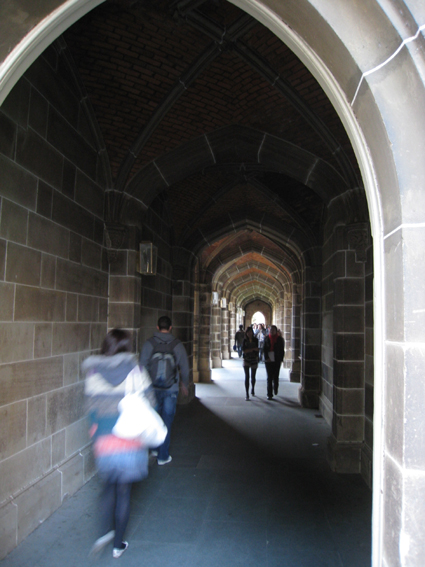
Melbourne University Quad
Students move through the dim stone archways of Melbourne University's Quad

As part of my ongoing debrief regarding the Universitas 21 Scholarship I undertook earlier this year I’ve been invited to talk at the first PGR Student Seminar this term, on Monday 1st December, from 12.30 – 1.30 pm.in Room B33, Dearing Building in the School of Education on Jubilee Campus. Refreshments will be available. These tend to be informal events focused on student perspectives. The blurb being circulated runs like this:

The speaker will be Sarah Lewthwaite who will be talking about Universitas 21. Sarah will talk about her experiences as a Universitas 21 visiting scholar at the Centre for the Study of Higher Education at the University of Melbourne, Australia. She will also discuss the application process for the U21 travel prize, and the practical aspects of making such a trip. If you are interested in applying for travel bursaries during the course of your studies, or finding out more about working internationally at other universities, this will be a ‘backstage’ look at how to get going!

I’ll be bringing along my application, as well as photos from the trip  – so if you think you’re interested in applying for this kind of scholarship in the future, do come along.

LSRI Seminar


LSRI Seminar Presentation

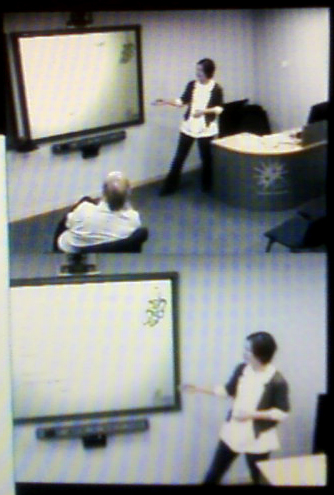
Thanks everyone who came along to my seminar at the LSRI yesterday, and to those who tuned in remotely! Thanks also to Dr Charles Crook, who chaired the session. If you missed the session, the video will be signposted from the LSRI Seminar pages when it becomes available. Pictured on the left is an image from the live video stream of the event. Two different angles on the room are presented, one wide angle, one close-up. If you’d like to request a copy of the slides, or anything else, please get in touch.

Post Graduate Conference


*Retroblogged!*

Today was the first Post Graduate Conference in the School of Education for 5 years. "Weaving the Strands of Education Research" focusing on the intersects between policy, research and practice, saw 95 delegates converge on the Dearing Building, including UoN staff and students, and students from several other universities. The keynote address was delivered by Prof. Jerry Wellington of Sheffield University. I was pleased to be involved in organising the conference, in a role relating to access and technical support. From this vantage point I know how well the student organising committee have worked together and individually, striving for a great conference, chaired by Cheryl Rounsville. But even I have been surprised by how things have finally turned out.  The quality of the papers and the generally supportive and positive atmosphere have come solely from the student group. As Education is a post graduate department at Nottingham, shared lectures across the department do not happen. Research training and seminars from different research centres do occur, but only allow small groups of students to meet at any one time, this can mean that getting a sense of the department and peers research is difficult. In effect, I feel, as a delegate, that this has been an invaluable event, for networking but also for morale. Hopefully this conference can be taken forward in 2009. Photos and video from the event will be linked from here.

LSRI Opening


LSRI Labyrinth
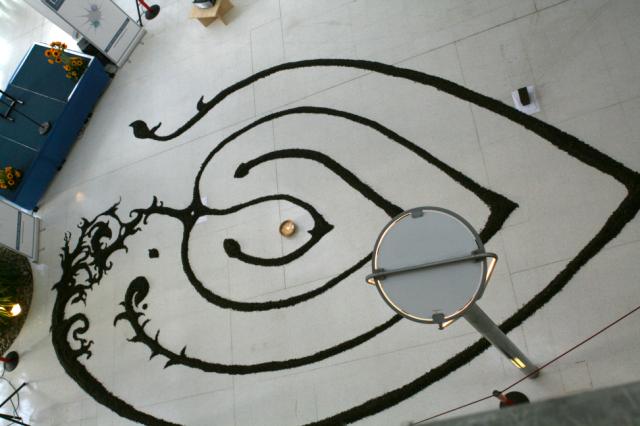
The LSRI Labyrinth

Friday the 7th of November was the happy occasion of the official opening of my research centre, the Learning Sciences Research Institute here at Nottingham. This was a great day including everything from project demonstrations, audio installations, video conferenced exchanges with the University of Nottingham’s Ning Bo campus, to cabinets of curiosities and the installation of Dr Matt McFall’s labyrinth (pictured above) laid out in the Exchange Building’s atrium.  The labyrinth is a path outlined in black in an organic shape close to a leaf or heart. The Institute was opened by Professor Roy Pea, co-director of H-Star (Human-Sciences and Technologies Advanced Research Institute) at Stamford University.  Professor Pea also gave a thought provoking keynote entitled ‘Fostering learning in the networked world’.  For those wishing to experience the event once more – photos are now available here.  I’ll add links to Prof. Pea’s presentation when it goes live, I’m certainly looking forward to a repeat viewing.

Research on Tour


Things have been seemingly very quiet here at 32 Days. This belies a flurry of activity behind the scenes. Firstly I’ve been doing a lot of interviews with Freshers here at Nottingham. Secondly there have been several events I’ve been to be involved in and attending – notably the official opening of the Learning Sciences Research Institute, the NTU Interactive Technologies Conference and recent workshop on Evaluation and Learning Spaces. I’ll be retro-blogging these and other events and linking back into October’s apparent void from here. Brace yourself. Other news includes some forthcoming seminars I’ll be giving:

  • Tuesday 25th November, 4pm @ Learning Sciences Research Institute, University of Nottingham.  This will be the first time I present to my peers here at the LSRI.
  • Friday 28th November, 1.30pm @ Human Centred Technology Research Group Seminar, University of Sussex.
    I’ll be very interested to find out more about the HCT group and its work. The HCT research group consists of two sub-groups; IDEAs lab and Interact lab. the IDEAs lab (Interactive Digital Educational Applications) encompasses the fields of artificial intelligence, education, cognitive science, psychology and computer science.  The Interact lab is focused on a user-centred approach to understanding and designing for interactions between people and technologies in everyday contexts.
  • Friday 5th December @ Liverpool John Moores University.
    In association with Liverpool John Moores University’s MA in Communication and Internet Studies ‘Critical Internet Studies’ Seminar Series, the Cultural Disability Studies Resarch Network (CDSRN) have organised this workshop entitled ‘Disability and the Internet: Access, Mediation, Representation’. This promises to be an extremely interesting day for anyone interested in the sociology of the internet and disability studies.

LSRI Opening Event


Today was the official opening of the Learning Sciences Research Institue. Reterospective photos and thoughts available here!

Online Publishing and Visual Sociology


Following on from the Live Sociology workshop the other week, I’ve been thinking a lot about online publishing, blog and hard copy, and e-books (both onscreen and as mobile hardware).  Along the way, thanks to Jan Brauer’s Gono-Gono arts blog, I’ve stumbled upon http://issuu.com/

Issuu allows you to upload PDFs into a book format.   This can then be ‘read’ online – and perhaps more importantly – copyright protected or made available for embedding into blogs, networks or wikis etcetera. Shown above is an example of a book being previewed in its embedded form. The pages are turning automatically, with pictures of smiling students shown, although the accompanying text is too small to make out. Links can be followed though to full screen viewing pages, where the ‘book’ comes into it’s own.  It’s a good looking thing with excellent zoom and good resolution (although a little small in preview here on my humble blog). Although I wonder how accessible it can be as stand alone Flash device, clearly there is a PDF equivalent that can be requested or made available from the source (for advice on making Accessible PDFs, check out the UK’s JISC TechDis pages on Making the Most of PDFs).

A quick thumb through issuu’s library shows that Edinburgh University is already using it as a platform for their prospectus (shown above), with academics illustrating their publication CVs also.  This appears to be a tool yet to reach any critical mass, and graphical books appear to me to be where the platform works best, however, an interesting development for PDF viewers and vehicles all the same?

Help Save the Accessibility Institute


I’ve copied the below text directly from DotJay, please act on this.

‘Most people with an interest in web accessibility are likely to have at some point stumbled across the work of the Accessibility Institute at the University of Texas in Austin, which was founded by the late Dr. John Slatin.

The University of Texas has decided to close the Accessibility Institute, which has been a guiding light in our field, giving important opportunity for research and providing useful resources to the world. It would be a real blow to web accessibility to see it go.

If you care about web accessibility, please show your support by putting your name on the petition to save the Accessibility Institute that Knowbility have set up. It only takes a few seconds to do.

There are some great thoughts and comments from people who have signed the petition. Henny Swan has also given some reasons to keep the Institute going on her blog:

Reasons for saving the Accessibility Institute include:

  • Need for research based findings to support accessible design practice.
  • Opportunity for a world class institution like UT to serve as an example to other institutions.
  • Place where emerging practices can be tested and modelled.
  • Contributions to international body of knowledge on inclusion.
  • Maintain thought leadership in Texas, easily disseminated to state agencies that have accessibility mandates.

Thanks for taking the time to read this. Extra special thanks if you have signed the petition.’

Academic Network of European Disability Experts


Today was the final day of the UK Disability Studies Association conference in Lancaster.  As almost a footnote to the conference Mark Priestley announced the launch of the European Commission’s ‘Academic Network of European Disability Experts’ (ANED) at http://www.disability-europe.net/

Some of the major themes of the Lancaster conference were international concerns – particularly relating to the North/South divide, the export and commercialisation of disability and impairment (in terms of war, arms proliferation, pharmaceuticals, pollution, global warming, (e)sweatshops, etc.) – alongside those of more local UK national policy making.  Within this dichotomy of Home and Abroad, it initially appeared to me that Europe, and in particular EU legislation and it’s impact on British governance, was under-represented.  ANED, however, appears to represent an ambitious and major step forward in addressing policy at the European level. In its own words, the Academic Network aims to support the objectives of European disability policy towards the goal of full participation and equal opportunities for all disabled people.

‘ANED builds upon the expertise of existing disability research centres and national networks, supported by contacts in each country, expert rapporteurs in specific themes, and links to other policy and research networks. In this way, it provides a co-ordinating infrastructure of academic support for practical implementation of the European Disability Strategy and the United Nations Convention on the Rights of Persons with Disabilities in Europe.’