I’ve been seeking out Doing Disability Research, edited by Colin Barnes and Geoff Mercer along with some other books strangely absent from the UoN libraries. This book appears to be currently out of print – however, in my search I’ve discovered the excellent Leeds Disability Studies Archive UK, an online resource containing Doing Disability Research by chapter and many other relavent titles. Explore for yourself at http://www.disability-archive.leeds.ac.uk/
I made the mistake of exploring Nottingham’s Blackwells during the sales. Hard on the wallet! These were some of the half-price bargains I found.
Exhausting Modernity begins with much literary talk of the devil and the means of production, as such I thought it was worth a punt. If I can lever some Dante into my thesis I’ll be very pleased, and this could be the way! The Inclusive society seemed a slight risk as this kind of literature dates quickly, but it employs three key conceptions of inclusion in New Labour ideology that I need to get a strong grip on (especially with the Melbourne visit pending). Wild Science is tricky. There seem to be a lot of these kind of collected gender essays – and often it’s difficult to judge the strength of the theme and the resulting relevance of the writing. This book, however, features ‘Teaching in the Belly of the Beast: Feminism in the best of all places’ by Anne Balsamo. She’s always worth reading. Likewise for Processed Lives which features a chapter by the excellent Nina Wakeford.
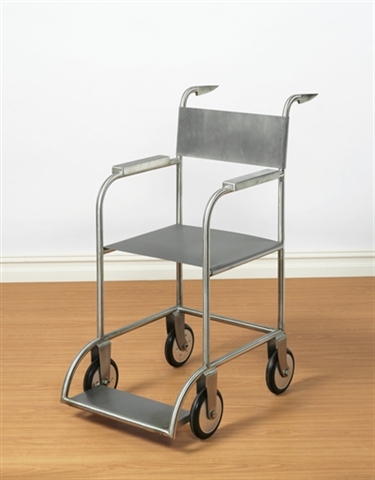
I’ve recently been reading Tom Shakespeare’s Disability Rights and Wrongs, a book that has been cropping up on every Disability Studies reading list. At the recent Disability Research Forum at Sheffield Hallam, discussion of the book kicked off with consideration of the front piece, a work by artist Mona Hatoum. I was the only member of the group to have seen wider examples of Hatoum’s work, and I think for those interested in exploring cultural conceptions of disability her work is deeply rewarding. Untitled (Wheelchair) pictured left, is used for Shakespeare’s cover. This is one of a series of works, all of which deal with the body in its absence. I will not describe my reaction to these sculptures, as they are open to interpretation, but it is difficult to consider these images without being drawn into them. This image shows a steel wheelchair, hard and uncompromising, on casters. It looks like institutional furniture. However, this is not the architypal Model 8F wheelchair of the NHS. It appears instead more like a hospital’s kitchen trolley. Two kitchen knives emerge where the handles should be.
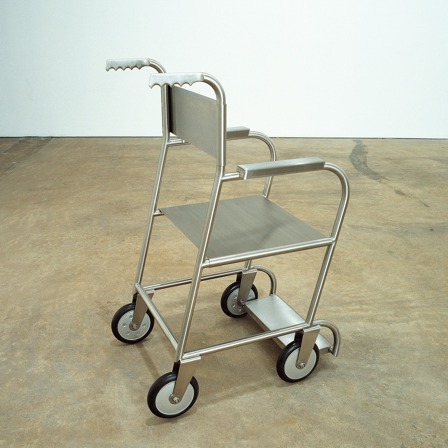
Untitled (Wheelchair II) sculpture by Mona Hatoum
Untitled (Wheelchair II) seemingly repeats this image. However, the handles are now deeply serated knives, the chair is slanted forwards at an angle like an italic letter. Movement and speed seemingly enter the picture, implying a pushing force.
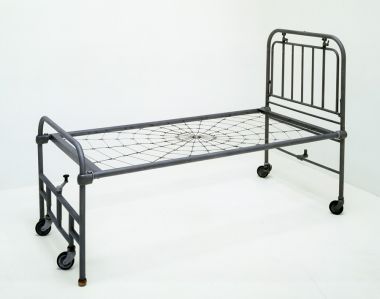
A third image from this series is Webbed 1 (below). This sculpture, again in grey steel, depicts a hospital bed. The springs of the bed are arranged as a spiders web. To find out more about Hatoum’s art, publications and exhibitions, and to see these works in more detail visit her pages at the White Cube Gallery.
Web 2.0 in action in so many ways. The image shows a Threadless.com favourite t-shirt design: ‘Technology Ruins Nature’, by Leon Ryan. Threadless is a t-shirt shop and community site rolled into one. Anyone can put forward a t-shirt design, and site users vote for their favourites which are ‘published’. This decal depicts the silhouette of a bear slouched in a forest lit only by a TV.
I’ve recently picked up a copy of Oliver Postgate’s autobiography "Seeing Things" on ebay. Seeing Things is currently out of print, but has plenty to say about the current state of Children’s Educational Television, an area I’m currently writing about in support of a piece on wider Educational Technology.
Postgate was instrumental in creating some of the most memorably children’s television of the 1970 and 80s. I say so because I remember it, having been a small child at the time. On the subject of the state of current children’s programming Postgates own website has a short essay – "Does Children’s Television Matter?". This cites commercial styles of programming and American research as fundamental catalysts for the decline of the genre.
Then, in 1987 the BBC let us know that in future all
"programming" was to be judged by what they called its "audience ratings".
Furthermore, we were told, some U.S. researchers had established that in order
to retain its audience (and its share of the burgeoning merchandising market)
every children’s programme had to have a ‘hook’, ie, a startling incident to
hold the attention, every few seconds. As our films did not fit this category
they were deemed not fit to be shown by the BBC any more. End of story – not
only for Peter and me – we had had a very good innings – but also for many of
the shoe-string companies that had been providing scrumptious programmes for
what is now seen as ‘the golden age of children’s television’.
Those days
are long gone. Today making films for children’s television has become very big
business requiring huge capital investment, far beyond the reach of small
companies, and that has inevitably brought with it a particular poverty from
which we never suffered.
Until the next edition of "Seeing Things" this essay is a touchstone in view of current debates on Children’s Television programming.
I’ve just had news from CustomPC that my interview with Peter Norvig has been picked up by Slashdot (prima techi debate site). Much argument insues concerning the Google/hardware debate. This article will probably move from the front page in due course: to lurk or contribute to the discussion, go to: http://hardware.slashdot.org/hardware/07/09/14/1227202.shtml. That’s 23 comments and counting…
A query came up yesterday on the JISC DIS-FORUM concerning recording equipment. I responded and duplicate here. For reference, a good UK website for dictaphones and other recording equipment is http://www.speakit.info/. They also give very good professional advice over the phone. I use an Olympus WS-300 that has proven invaluable in vast lectures, intimate interviews and has an epic memory and battery life. Perhaps more importantly, a small red light that shows when it’s recording.
The most recent fruit of this device (ALTC reviews and Norvig interview) have been submitted to CustomPC and now face the editors cut.
I’ve been invited to join the advisory committee for the LExDIS project at the University of Southampton and am looking forward to contributing. This has spun out of a brief meeting with Jane K. Seale (whose writings on assistive technologies in higher-education underscore founding elements of my MA) during my ITISCE working group visit in June.
Lexdis is an important project exploring the e-learning experiences of disabled learners at Southampton. If you are interested in this area, and/or participatory research methods in higher education do explore the LExDIS website at: http://www.lexdis.ecs.soton.ac.uk/.
On the subject of consumables, I recently picked up an Incase neoprene sleeve for my laptop. These are available all over the place in varying sizes, and are a handy alternative to a specific laptop case. I can now get my notebook in my NNDR conference satchel, or any other bag, with or without a tonne of papers, it can be carried more covertly on the train, and it makes me long for the time when the surf starts to improve come autumn. Marvellous.